.png)


Complete Guide to the Role of Email Automation

Over 80 percent of American businesses now rely on email automation to reach customers more efficiently. With technology rapidly changing marketing strategies, standing out in crowded inboxes is more challenging than ever. Understanding the latest email automation concepts can help American brands build stronger relationships, boost customer engagement, and make every message count with less manual effort.
Table of Contents
- Defining Email Automation And Core Concepts
- Types Of Email Automation For E-commerce
- How Email Automation Drives Customer Engagement
- Implementing Successful Automated Campaigns
- Common Mistakes And How To Avoid Them
Key Takeaways
| Point | Details |
|---|---|
| Email Automation Enhances Marketing | Automated email campaigns personalize communication and improve customer engagement by sending timely messages triggered by specific user actions. |
| Core Components are Essential | Successful email automation relies on triggers, segmentation, personalization, and performance tracking to create effective communication workflows. |
| E-commerce Benefits from Automation | Email automation types, such as abandoned cart emails and retention campaigns, drive sales and enhance customer loyalty for e-commerce businesses. |
| Avoid Common Mistakes | To optimize email campaigns, avoid over-messaging, maintain personalization, ensure proper segmentation, and regularly test automation workflows. |
Defining Email Automation and Core Concepts
Email automation represents a powerful digital marketing strategy that enables businesses to send targeted, personalized messages to customers automatically based on specific triggers or predefined conditions. At its core, email automation transforms traditional communication approaches by leveraging technology to deliver timely, relevant content without manual intervention.
Modern email automation goes far beyond simple scheduled sending. Advanced systems now integrate artificial intelligence to create sophisticated communication workflows. Researchers have demonstrated remarkable developments in this space, such as AI-powered methods for automatically generating email responses that can classify, analyze, and even draft contextually appropriate messages.
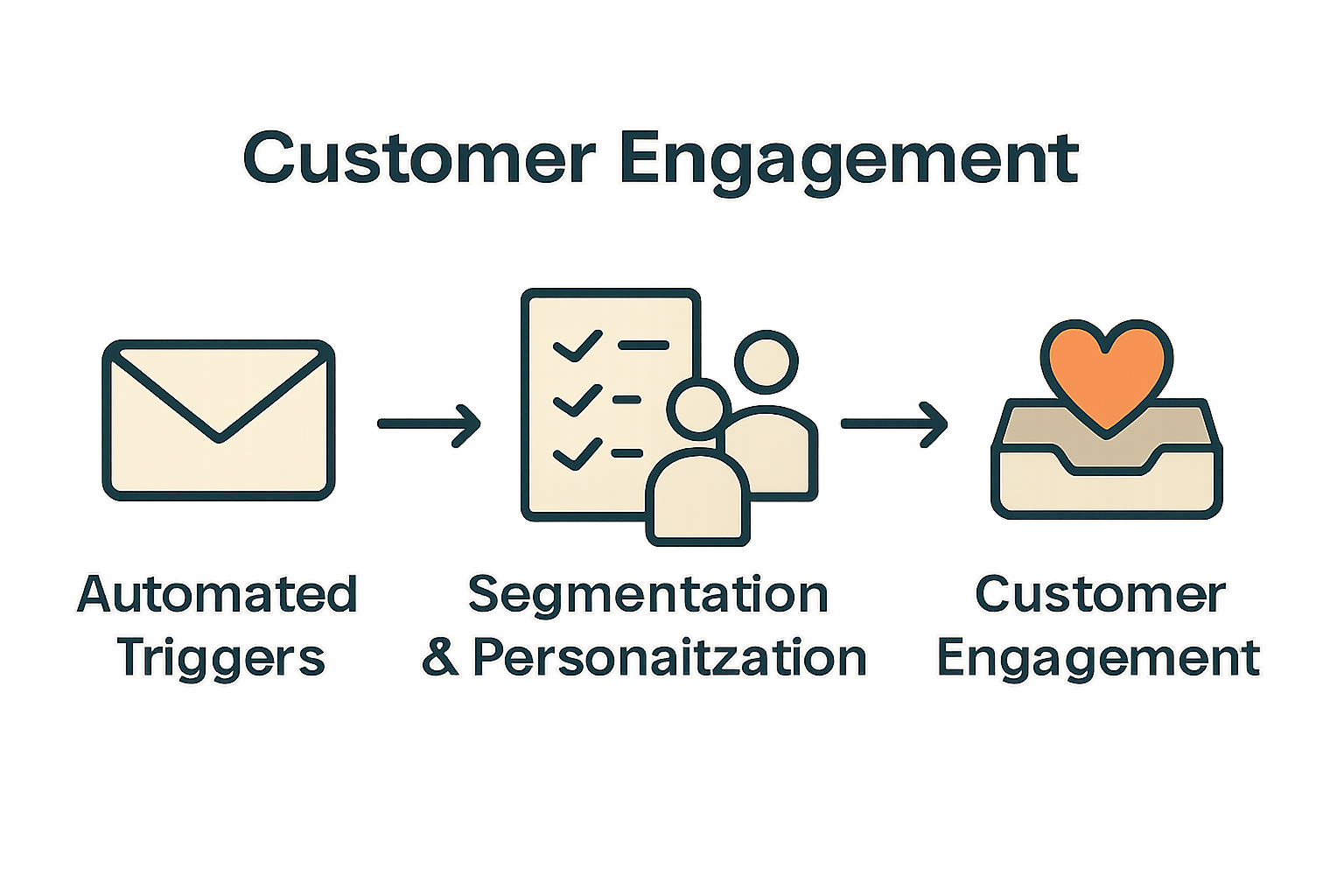
The fundamental components of email automation typically include:
- Triggers: Specific actions or conditions that initiate an automated email sequence
- Segmentation: Categorizing subscribers based on behaviors, demographics, or engagement levels
- Personalization: Customizing content to match individual subscriber characteristics
- Performance Tracking: Monitoring key metrics like open rates, click-throughs, and conversions
By implementing strategic email automation workflows, businesses can dramatically improve customer engagement, reduce manual marketing workload, and create more intelligent, responsive communication strategies that adapt in real time to customer interactions.
Types of Email Automation for E-commerce
E-commerce businesses leverage multiple email automation types to streamline customer communication, enhance engagement, and drive sales. Intelligent systems now enable sophisticated automated workflows that transform how online retailers interact with customers throughout their purchasing journey.
Personalized email communities have revolutionized targeted marketing by enabling precise customer segmentation and automated communication strategies. The primary types of email automation for e-commerce include:
- Welcome Sequence
- First email after subscription
- Introduction to brand
- Special welcome offer
- Abandoned Cart Emails
- Triggered when customers leave items in cart
- Reminder of unpurchased products
- Potential incentives to complete purchase
- Post-Purchase Flows
- Order confirmation
- Shipping updates
- Product care instructions
- Request for product review
- Retention Campaigns
- Reengagement emails for inactive customers
- Personalized product recommendations
- Exclusive loyalty rewards
- Browse Abandonment Emails
- Triggered by product page visits without purchase
- Showcasing viewed items
- Social proof and urgency tactics
E-commerce marketing strategies demonstrate that these automated flows can significantly increase customer lifetime value by creating timely, relevant, and personalized communication touchpoints that guide customers through a seamless purchasing experience.
How Email Automation Drives Customer Engagement
Customer engagement represents the critical lifeline for modern businesses, and email automation has emerged as a powerful mechanism for creating meaningful, personalized interactions. Intelligent automation strategies leverage advanced technologies to transform how brands connect with their audiences, moving beyond traditional communication approaches.

Machine learning techniques have revolutionized marketing automation by enabling predictive user engagement strategies. These sophisticated systems analyze customer data, past behaviors, and interaction patterns to craft highly targeted communication that resonates with individual preferences. The result is a more nuanced, responsive approach to customer relationship management.
Key mechanisms through which email automation drives engagement include:
-
Personalization at Scale
- Dynamic content tailoring
- Behavior-triggered messaging
- Segment-specific communication
-
Timely and Relevant Interactions
- Contextual messaging based on customer journey
- Immediate response to customer actions
- Proactive communication strategies
-
Data-Driven Insights
- Real-time performance tracking
- Continuous optimization of communication
- Predictive customer behavior modeling
Intelligent marketing automation reduces operational overhead while simultaneously enhancing marketing precision. By creating scalable, data-driven outreach strategies, businesses can transform email from a simple communication channel into a robust engagement ecosystem that anticipates and fulfills customer needs before they even articulate them.
Implementing Successful Automated Campaigns
Automated email campaigns require strategic planning and precise execution to deliver meaningful customer experiences. Sophisticated email automation tools now provide advanced capabilities that enable businesses to design complex, responsive communication workflows tailored to specific customer behaviors and preferences.
Transactional email strategies have revolutionized how brands approach customer communication, transforming routine interactions into opportunities for engagement. Successful implementation demands a systematic approach that encompasses several critical components:
Key Implementation Strategies:
-
Segmentation and Targeting
- Define precise audience segments
- Map customer journey stages
- Create behavior-based triggers
-
Content Design
- Develop personalized message templates
- Ensure consistent brand voice
- Optimize for mobile responsiveness
-
Technical Configuration
- Select appropriate automation platform
- Integrate with existing customer databases
- Set up comprehensive tracking mechanisms
-
Performance Monitoring
- Establish key performance indicators
- Implement continuous A/B testing
- Track engagement and conversion metrics
Drip email marketing provides a structured framework for delivering these automated campaigns, enabling businesses to create sophisticated, multi-stage communication sequences that adapt dynamically to individual customer interactions and preferences.
Common Mistakes and How to Avoid Them
Email automation presents complex challenges that can significantly impact marketing effectiveness. Comprehensive email automation campaigns require strategic planning and careful execution to prevent common pitfalls that could compromise communication quality and customer engagement.
The most critical mistakes in email automation often stem from inadequate segmentation, poor personalization, and neglecting continuous optimization. Businesses frequently underestimate the importance of granular audience targeting and dynamic content adaptation, which can lead to decreased open rates and diminished customer interest.
Key Mistakes to Avoid:
-
Over-Messaging
- Bombarding subscribers with excessive emails
- Ignoring subscriber preferences
- Failing to establish communication frequency
-
Lack of Personalization
- Using generic, one-size-fits-all content
- Neglecting behavioral data
- Missing opportunities for contextual messaging
-
Inadequate Segmentation
- Treating all subscribers identically
- Not considering customer lifecycle stages
- Overlooking demographic and behavioral differences
-
Technical Implementation Errors
- Improper trigger configurations
- Inconsistent tracking mechanisms
- Failure to test automation workflows
Drip email marketing strategies can help mitigate these challenges by providing structured frameworks for creating intelligent, responsive communication sequences that adapt to individual customer interactions and preferences.
Elevate Your Email Automation Strategy with Expert Guidance
The article uncovers the challenges of executing effective email automation such as inadequate segmentation, lack of personalization, and poor trigger configuration. If you want to transform these pain points into powerful growth opportunities, it is crucial to implement targeted workflows, dynamic personalization, and data-driven optimization. These core concepts are the foundation for turning automated emails into a robust engagement tool that drives customer loyalty and repeat sales.
At The Email Marketers, we specialize in building AI-driven automated flows and segmentation strategies tailored specifically for e-commerce brands striving to maximize customer lifetime value. Our team crafts highly personalized campaigns that align with your customer journey to increase engagement and conversions. Don’t let common automation mistakes hold your brand back. Experience the difference of working with experts who prioritize strategy and results. Learn how our comprehensive retention marketing solutions can transform your email performance by visiting The Email Marketers today. Take control of your email automation success now and turn casual subscribers into raving fans.
Frequently Asked Questions
What is email automation and how does it work?
Email automation is a digital marketing strategy that allows businesses to send personalized messages to customers automatically based on specific triggers or conditions. It works by using advanced systems to set up workflows that send out emails at the right time, targeting the right audience, without manual intervention.
What are the main types of email automation used in e-commerce?
The main types of email automation for e-commerce include welcome sequences, abandoned cart emails, post-purchase flows, retention campaigns, and browse abandonment emails. Each type targets specific interactions and customer behaviors to enhance engagement and improve sales.
How can businesses avoid common mistakes in email automation?
Businesses can avoid common mistakes in email automation by focusing on proper segmentation, avoiding over-messaging, ensuring personalization, and meticulously testing automated workflows. This includes establishing clear audience segments and continuously optimizing email content based on performance metrics.
How can email automation improve customer engagement?
Email automation improves customer engagement through personalized interactions, timely messaging based on customer actions, and data-driven insights. By creating tailored content and responding promptly to customer behaviors, businesses can foster deeper relationships with their audience.
Recommended
- The Basics of Email Automation in 2023
- Email Automation: A Deep Dive Into One Of The Must-Have Email Marketing Tools
- What Is an Email Marketing Automation Agency? (And What Is the Best Automation Agency?)
- What Is an Automated Email Response?
- Understanding the Importance of Customer Communication – My WordPress


