.png)


The Best Ecommerce Email Marketing Agencies in 2026

Last updated: August 19, 2026 · By Melanie Balke, Founder & CEO, The Email Marketers
The best ecommerce email marketing agency for most 7 to 9-figure DTC brands is one that staffs senior specialists on your account, proves its results with numbers you can audit instead of vague ROI banners, and prices transparently. Ten agencies clear most of that bar in 2026. This guide compares all ten, including us, The Email Marketers, using a 100-point rubric you can recalculate yourself. It also publishes something no other ranking for this search has: our actual 2026 performance benchmarks from the ecommerce accounts we run, including the flows-versus-campaigns split that contradicts the advice everyone repeats. The Shopify question gets its own section, because your platform changes the answer in exactly two places.
Key Takeaways
- Expect to pay $1,500 to $18,000+ per month. Production shops start near $1,500. Boutique consultancies list $1,000 project minimums. Full-service and premium teams carry $5,000 to $10,000 project minimums, and premium retainers reach $18,000. Only two of the ten agencies here publish what they actually charge, which tells you something on its own. Our rate card is one of the two and it is below.
- Brands arrive at about 15% of revenue from email, and six months in they should be past 25%. For subscription or high-repeat products, 30 to 40% is the realistic zone. Anyone who quotes you "30 to 50%" without asking what you sell is guessing.
- The 2026 benchmarks, from our own accounts: 60 to 65% open rates on well-segmented campaigns (inflated by Apple, more below), 0.7 to 1.3% click rates now that bot clicks are filtered out, and 12 to 30 campaigns a month for 7 and 8-figure brands. If an agency pitches you 2019 numbers, they have not run an account recently.
- Roughly 70% of email revenue comes from campaigns in our most mature accounts, not 50%. The 50/50 flows-to-campaigns rule you have read everywhere describes an account mid-rebuild, not a finished one.
- Full disclosure: The Email Marketers wrote this guide and appears at #1. The rubric is published below with every agency's score, so check our work, then re-weight it and watch the order change.
- For Shopify brands, the agency question has a twist: whether you need email only, or email plus site work. It gets its own section.

What Should a Well-Run Ecommerce Email Program Look Like in 2026? Our Benchmarks
Nobody publishes real ecommerce benchmarks, so here are ours, pulled from the accounts we run and the accounts we audit. Screenshot this section. It is the fastest way to grade your current program, or the agency running it.
Open rates: 60 to 65% on well-segmented campaigns. When I started in email, 15% was the number everyone chased. Our well-optimized accounts now sit at 60 to 65%. Two things happened at once. Segmentation got dramatically better, and Apple Mail Privacy Protection started auto-opening emails, which inflates opens for every sender on earth. Both are true. That is exactly why opens are a health signal and not a success metric. We watch them for deliverability. We judge programs on clicks and revenue.
Click rates: 0.7 to 1.3% is strong now. The old standard was 1 to 3%. Then the platforms started filtering out bot clicks, the security scanners that "click" every link in an email before a human ever sees it, and reported click rates corrected downward across the whole industry. A 1% click rate on a well-segmented ecommerce campaign in 2026 is a good result. An agency bragging about 3% clicks is either cherry-picking a tiny segment or reporting scanner traffic as engagement.
Flows versus campaigns: the common advice is wrong at the top. You will read everywhere that a healthy ecommerce account runs 50/50 flows to campaigns. Here is what we actually see. In our most optimized accounts, the ones with a complete flow library, real segmentation, and a warm list, roughly 70% of email revenue comes from campaigns and 30% from flows. The nuance matters, so here is the whole picture. Early in an engagement, flows carry the program, because fixing broken automations is the fastest money in the building. Our client Gimme Seaweed's flows peaked at 67% of email revenue during that rebuild phase. A mature program does not stay there. Once the automation foundation is solid, campaign volume and campaign quality become the growth engine, and the ratio flips. If your account has been "done" for a year and flows still drive most of your revenue, your agency stopped sending.
Email to SMS: about 80/20. SMS earns its keep as a second channel, not a second program. Brands that push SMS toward equal weight usually just burn the list and then wonder why their opt-out rate tripled.
Campaign cadence: 12 to 30 campaigns per month for 7 and 8-figure brands. Nine-figure brands scale past that. Four campaigns a month is not a strategy, it is a retainer being underdelivered. Do the math on your own store. If campaigns should be producing 70% of your email revenue and you are sending four a month, the gap is not a copywriting problem.
Popup signup rate: 6%+ is the new bar. The old best practice was 3%, and 3% is still roughly what a standard Klaviyo popup converts at. On Alia, the popup platform we deploy now, we hold accounts to a 6% minimum. The platform is simply better. On a store doing 100,000 sessions a month, that difference is 3,000 new subscribers versus 6,000, or about 36,000 extra subscribers a year, feeding every flow and every campaign you send after that. List growth is the input nobody wants to talk about because it is unglamorous, and it compounds harder than any subject line test you will ever run.
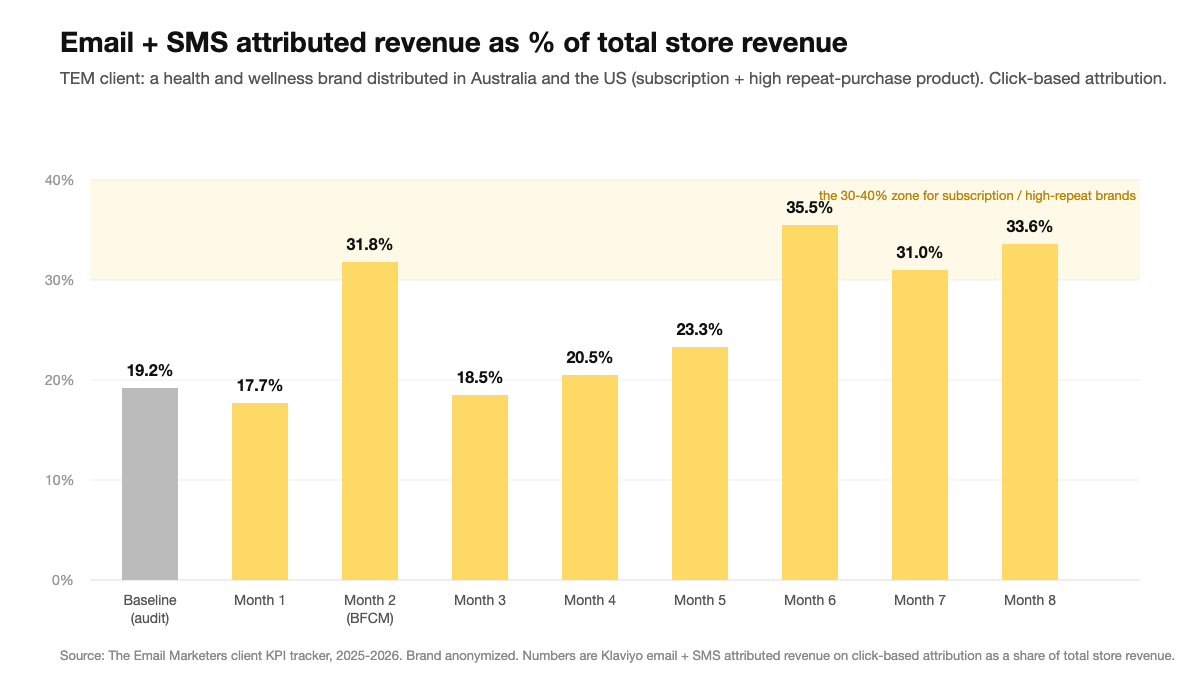
Where email revenue share should be, and by when. Brands typically arrive at about 15% of store revenue from email and SMS. Six months in, they should be above 25%. For brands with subscriptions or a high repeat-purchase product, 30 to 40% is realistic. On a $2M-per-month store, moving from 15% to 25% is $200,000 a month of revenue that was already sitting in your list. That is the money math that decides whether a $6,500 retainer is expensive.
Here is a real trajectory from our KPI tracker, anonymized: a health and wellness brand distributed in Australia and the US, subscription plus a high-repeat product. Baseline at audit: 19.2% of store revenue from email and SMS. Month 8: 33.6%, with month 6 peaking at 35.5%. Notice that it is not a straight line. Month 1 dipped below baseline while we rebuilt foundations. Month 2 spiked on BFCM. Month 3 gave some of that back. The trend is what compounds, and any agency showing you a straight line is showing you a slide, not a client.
Takeover to first revenue lift: 2 to 3 weeks. That is our number, and it comes from quick-win campaigns, the sends that get us aligned on your branding while grabbing the lowest-hanging fruit for the fastest ROI. Any agency quoting six months before you see anything is planning to hide.
The takeaway: grade every agency on this list, including us, against these numbers. They are current as of August 2026 and we update them as the accounts move.
How We Scored the Agencies (Check Our Work)
Every ranking you will find for this keyword was written by an agency or a content site, and most of them put themselves first without saying so. We are on this list too. Rather than pretend to be neutral, here is the exact 100-point rubric with every score published. Re-weight it and your #1 changes. That is how rankings honestly work.
- Verifiable results, 30 points. Published case studies with real numbers and named clients, ideally with attribution settings visible. Logo walls and unattributed "$100M generated" banners score zero here.
- Who does the work, 25 points. Senior, accountable, meetable teams score high. Junior or anonymous delivery scores low, no matter how good the sales call was. We read Clutch reviews, team pages, and each agency's stated delivery model.
- Ecommerce retention depth, 20 points. Is email and SMS the core craft, or one service among twenty? Generalists can appear on this list, but they get framed as generalists.
- Pricing transparency, 15 points. Published rates or honest minimums beat "book a call to find out."
- Verified current activity, 10 points. Every agency here was checked as operating in its claimed form on August 19, 2026, on its own site, on Clutch, and in the Klaviyo partner directory. Lists get copied from lists, and stale facts propagate for years. We actually looked, and the August pass changed real things: two agencies had moved domains, one agency's headline pricing turned out to be double what every ranking page (including our own last version) had been repeating, and two agencies that everyone cites as Clutch-reviewed have empty Clutch profiles today.
The scores, so you can argue with them: The Email Marketers 91, Flowium 84, Underground Ecom 80, Fuel Made 79, MH Digital 77, Chronos 76, Hustler Marketing 75, Homestead Studio 72, Sticky Digital 69, InboxArmy 67.
We lose points on pricing transparency (we are premium and we say so) and win them back on verifiable results and senior-only staffing. Weight pricing transparency at 40 instead of 15 and InboxArmy climbs past most of this list, because they are one of very few agencies here who publish an actual pricing page rather than a "book a call" button. Weight senior US attention above everything else and MH Digital moves up. Agencies that also appear in our Klaviyo agency guide carry the identical score on both pages, on purpose. If our own ranking shifted depending on which page you landed on, you should not trust either one.
One thing to know before you read anyone's partner badge
Klaviyo's own partner directory writes the tiers as "Elite Master" and "Platinum Master." Almost every agency writes them in marketing copy as "Master Elite" and "Platinum." Same tiers, inverted words. It sounds like a nitpick until you realize how many ranking pages copy an agency's self-description without ever opening connect.klaviyo.com. And the tiers themselves are earned largely by referring business to Klaviyo and managing volume, so treat any badge as evidence an agency is established and certified, not as evidence they will be good for your brand. Verify at connect.klaviyo.com and weigh the other four criteria at least as heavily.
Best Ecommerce Email Marketing Agencies Compared
| Agency | Score | Best for | Starting price | Team model | HQ |
|---|---|---|---|---|---|
| 1. The Email Marketers | 91 | 8-figure DTC brands that want senior-only retention | $4,400/mo (avg $6,500), published | 5 senior specialists per account, US-led | Los Angeles, CA |
| 2. Flowium | 84 | Growth-stage brands that want systematized full service | $1,000+ minimum, $100-149/hr | ~6-person pods, distributed | Staten Island, NY |
| 3. Underground Ecom | 80 | 8 to 10-figure brands, especially UK and EU | Unpublished (five figures monthly) | 120+ staff, layered teams | London, UK |
| 4. Fuel Made | 79 | Shopify Plus brands that want dev, CRO, and email together | $10,000+ minimum, $150-199/hr | 17 all-senior, all-US | Colbert, WA |
| 5. MH Digital | 77 | Sub-$10M brands that want senior US co-pilots | $1,000+ minimum, $50-99/hr | Boutique, 2-9 people, all-US | Denver, CO |
| 6. Chronos Agency | 76 | Fast-scaling brands that want email, SMS, and push | $10,000+ minimum, $100-149/hr | ~80 staff, APAC delivery | Singapore |
| 7. Hustler Marketing | 75 | Value-conscious brands that want big-agency output | $5,000+ minimum, $10K-49K typical | 4-person pods, global remote | Jackson, WY (remote team) |
| 8. Homestead Studio | 72 | Acquisition and retention under one roof | $5,000+ minimum, $200-300/hr | Full-funnel team, now part of Verndale | Appleton, WI |
| 9. Sticky Digital | 69 | Beauty, wellness, and F&B boutiques | $1,000+ minimum, $100-149/hr | Boutique, female-founded | San Diego, CA |
| 10. InboxArmy | 67 | Volume execution and multi-ESP teams | $1,500/mo managed, published | 120+ production team, 40+ ESPs | Grapevine, TX |
Starting prices are the minimums each agency publishes or lists on Clutch as of August 19, 2026, not sales-call quotes. Where an agency publishes nothing, the table says so. Note how many of these numbers are Clutch minimums rather than rate cards: that gap is the pricing transparency score in miniature.
1. The Email Marketers: Best for 8-Figure DTC Brands That Want Senior-Only Retention
Bottom line: The Email Marketers is a Los Angeles retention marketing agency that manages email, SMS, direct mail, subscriptions, and referral and loyalty programs for 7 to 9-figure ecommerce brands, and staffs every account with five senior specialists and no juniors.
We generated more than $103 million in attributed client revenue in 2025. We only hire people who have done this before, so there is no junior learning on your account, ever. Brands like Grüns, Gimme Seaweed, Elevate Outdoor Collective (the company behind K2 Skis and Völkl), Open Store, and Outer Furniture have worked with us, which means we know what working with the best in ecommerce actually looks like.
Most agencies on this list manage email and SMS. We run the whole retention program and keep asking one question: how do we grow your profit and your customer lifetime value? That shows up in the deliverables. Every client gets a monthly email revenue forecast, a rolling 90-day roadmap, board-ready reports covering what was done, what was learned, and what happens next, and a proprietary performance dashboard. Clients tend to notice the proactivity first. You do not chase your agency. Your agency chases you. The team at BodyBio put it this way: "They are so on top of it that it's an adjustment in a good way. Very happy."
Verified results, all case studies public on our site:
- The Freeze Pipe grew attributed email revenue 113% to $894,661 in five months, while total revenue doubled year over year to $3.49M. (Full case study)
- Llama Naturals went from $8,527 to $79,733 in monthly email revenue, an 835% increase, in under 60 days.
- Gimme Seaweed lifted flow revenue share from 46.6% to 67.3% of email revenue, with open rates climbing from 47.9% to 62.7%. (Full case study)
- V-Flat World increased first-time customer revenue 108% and email AOV 24% in a single quarter. (Full case study)

Pricing: published, which is still unusual here. Starts at $4,400/month, averages $6,500/month, runs to $18,000/month at full scope. That is premium on purpose. It is what an all-senior, US-led, five-specialist team costs. Full breakdown in our pricing guide.
Retention Lab, for brands not ready for the full agency: a done-with-you coaching program for two kinds of brands. Larger brands building an in-house retention team who want senior operators teaching the playbooks. And smaller brands with someone smart internally who cannot yet justify a full retainer. Weekly strategy sessions, playbooks, and templates instead of a done-for-you team.
Honest fit-notes: the only thing we do not do is acquisition. No paid ads, no SEO, no site development. That is the boundary, and it is worth stating precisely because “not full-service” keeps getting misread as “email and SMS only.” It is not. The retention mandate itself is broad: email, SMS, direct mail, subscriptions, memberships, loyalty and referral. Premium priced by design, and I turn down business we cannot wow. Brands under seven figures should not hire us. At that stage the retainer eats the ROI, and MH Digital, Sticky Digital, or our Retention Lab is the better buy. I would rather say that here than on a sales call after you have already gotten your hopes up.
2. Flowium: Best for Growth-Stage Brands That Want Systematized Full Service
Bottom line: Flowium is a Klaviyo Elite Master agency founded in February 2017 by Andriy Boychuk that delivers email and SMS through standardized six-person account pods and tightly documented processes.
The systemization is the whole product. Audits, flow builds, and campaign calendars follow strict, repeatable processes, backed by one of the largest educational content libraries in email marketing. Clutch shows 23 reviews at 4.9, minimum projects from $1,000, and an hourly band of $100-149. Roughly 80% of the client base is midmarket. If you want a proven system rather than a bespoke engagement, this is the safest default on the list.
Pricing: verified minimum of $1,000 on Clutch at $100-149/hour. The $2,500 to $10,000 monthly retainer range that gets quoted everywhere, including in our own previous version of this page, traces back to Flowium's own blog rather than a published rate card. Directionally right, treat it as their number and not an audited one.
Honest fit-notes: email and SMS only, so no paid media, CRO, or development. The process is the product, which cuts both ways: brands that want individually tailored strategy find the templated cadence constraining. Clutch lists 50-249 employees, so the "six-person pod" is a delivery structure, not the size of the company you are hiring. The team is globally distributed and a minority of reviews mention timezone friction.
3. Underground Ecom: Best for 8 to 10-Figure Brands, Especially UK and EU
Bottom line: Underground Ecom is a London-based retention agency now describing itself as a global team of 120+, and it is Klaviyo's 2025 Agency Partner of the Year for EMEA, confirmed in Klaviyo's own partner awards newsroom rather than just on the agency's site.
Think of it as the Flowium model at enterprise scale: well systematized, fast-growing, and strong value for the team size you get. Accounts get layered support, a CRM director, a CRM manager, designers, copywriters, plus a senior strategy layer above all of it. AG1 is on the homepage client wall, and Huda Beauty and Oh Polly appear in their own published work. For enterprise muscle in the UK and Europe, nothing else here matches it. Klaviyo's directory lists them at Elite Master.
Pricing: unpublished. Effectively five figures monthly.
Honest fit-notes: no public pricing at all, which is exactly what costs them points on our rubric. The layered structure delivers consistency, and it also puts distance between you and the person actually doing the work, so brands that want one senior operator week to week will feel that. The Clutch footprint is thin relative to the headcount, so ask for referenceable clients before you sign, and ask which of the named logos are current rather than historical.
4. Fuel Made: Best for Shopify Plus Brands That Want Development, CRO, and Email Together
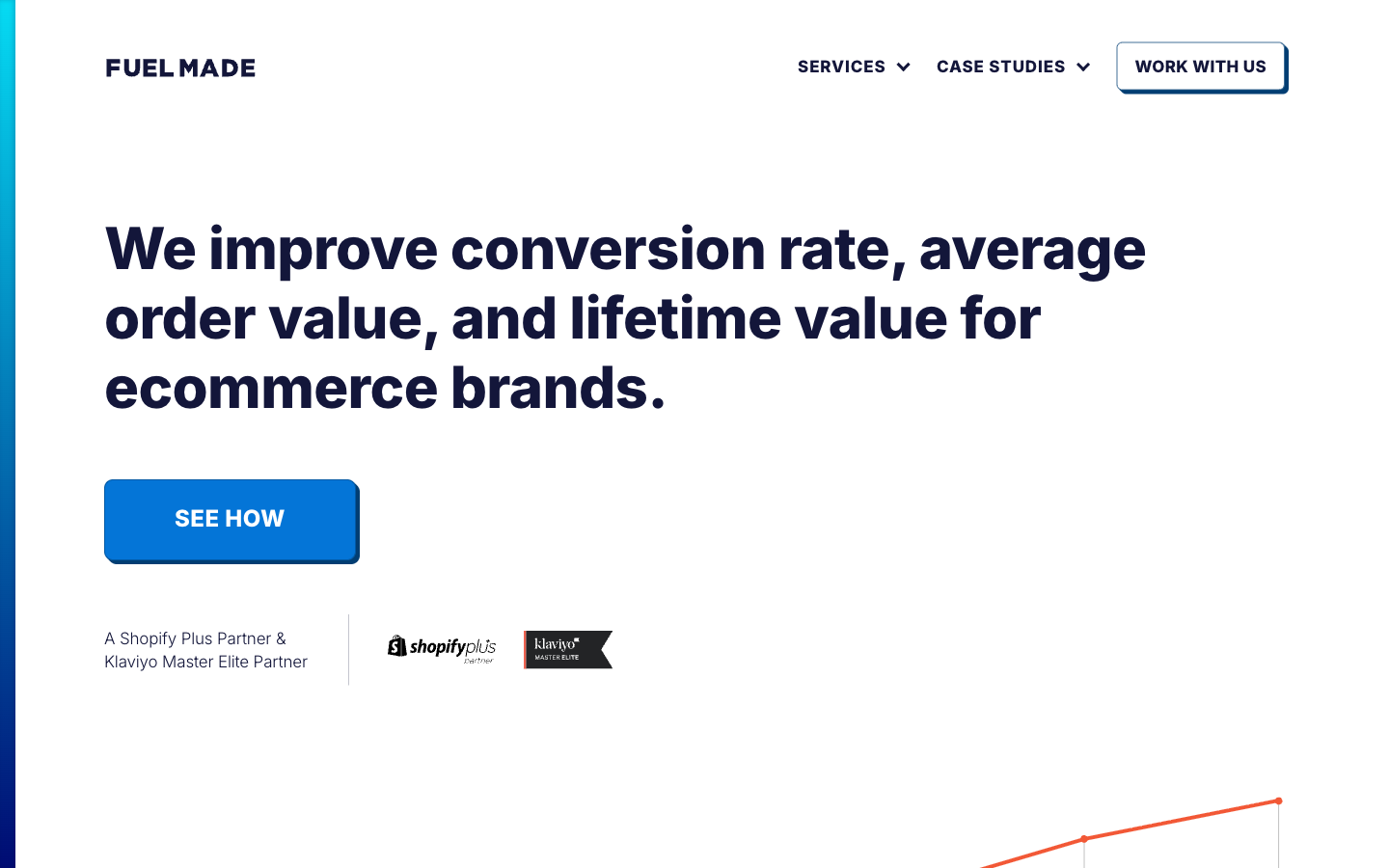
Bottom line: Fuel Made is a 17-person, all-senior, all-US agency out of Colbert, Washington, a Shopify Plus Partner since 2011, pairing Klaviyo Elite Master email work with Shopify Plus design, development, and CRO.
No other agency on this list holds top-tier credentials on both platforms. If your retention problems are tangled up with site problems, and they often are (leaky checkout, weak signup capture, slow product pages), one senior team fixing both sides is a genuine advantage no email-only shop can offer. 28 Clutch reviews at 5.0.
Pricing: $10,000+ minimum projects at $150-199/hour. Worth flagging: nearly every ranking page for this search, our own previous version included, still lists a $5,000 minimum for Fuel Made. Their Clutch profile says $10,000. If a comparison page has not updated that, ask what else on it is two years old.
Honest fit-notes: the trade-off to weigh is jack of all trades, master of none. We cannot say whether that applies to Fuel Made specifically, and their credentials on both sides are real, so check it yourself: ask for email-specific case studies, not blended ones. Their own materials say Shopify Plus Partner since 2011, and the company predates that, so "Shopify-only since 2010" (another line that gets copied around) is not quite their claim. Small capacity, premium rates, and now the highest project minimum on this list.
5. MH Digital: Best for Sub-$10M Brands That Want Senior US Co-Pilots
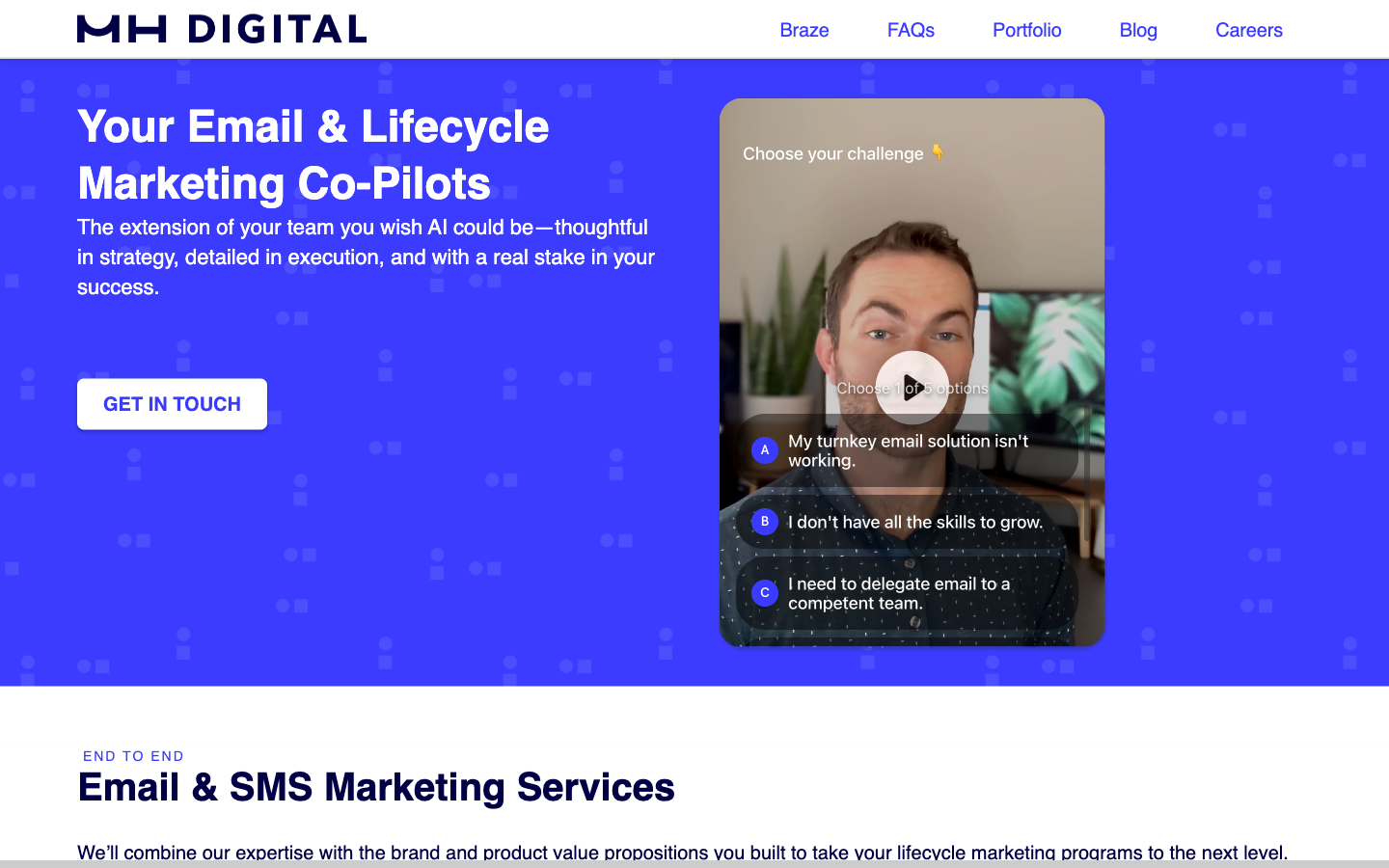
Bottom line: MH Digital (properly, MH Digital Consulting Group, at mhdigitalgroup.com) is a deliberately tiny 2 to 9 person, all-US lifecycle consultancy founded in 2017, led by principals Rob Howard and Adam Moncrief, positioning itself as email and lifecycle co-pilots rather than a production vendor.
Two things stand out. Genuine multi-platform depth, with Braze expertise alongside Klaviyo plus technical craft like AMP and dark-mode optimization. And the most accessible senior attention on this list: 24 Clutch reviews at 5.0, a $1,000 minimum, and an hourly band of $50-99, which is less than half what Fuel Made or Homestead charge for a senior hour. If you are under $10M and the real choice is between a junior pod at a big agency and a senior operator at a small one, take the senior operator every time.
Pricing: $1,000+ minimum on Clutch at $50-99/hour. Note that the "$2,000-5,000 per month pilot" figure that circulates for MH Digital, including on our own previous version of this page, is not published anywhere we could find. We removed it rather than repeat it.
Honest fit-notes: capacity-constrained by design. High-volume campaign production, or a brand that wants a full dedicated pod, will outgrow them fast. The two principals are no longer in the same city (Rob Howard is in Phoenix, Adam Moncrief in Denver), which matters only if you were buying "one room, one team." No stated Klaviyo partner tier and no directory listing we could find, which only matters if you screen on badges, and we have argued at length that you should not.
6. Chronos Agency: Best for Fast-Scaling Brands That Want Email, SMS, and Push
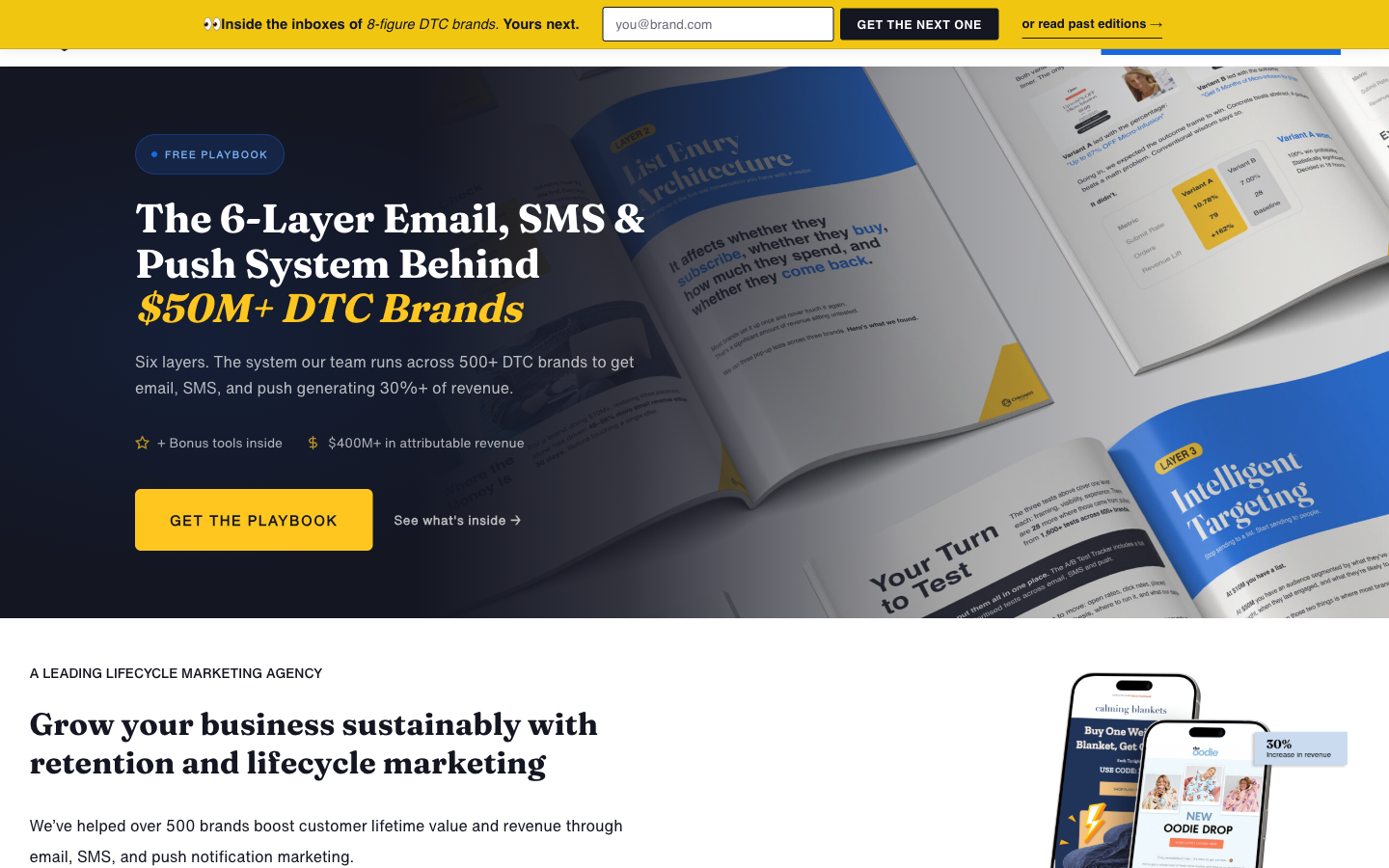
Bottom line: Chronos Agency is a Singapore-headquartered Klaviyo Elite Master agency of roughly 80 specialists, founded in 2017, now with a Sydney office as well, claiming 500+ brands served and $400M+ in email-attributed revenue.
Chronos adds push notifications, a channel most email agencies skip entirely, and it has one of the larger review bases in the category at 58 Clutch reviews, with roughly six people per account.
Pricing: Chronos does not publish rates. Its Clutch profile lists a $10,000+ minimum at $100-149/hour. The "$4,000-5,000 per month starter retainer" figure you will find repeated across ranking pages, ours included until this update, does not trace to anything Chronos published. Ask them directly and compare the answer to the Clutch minimum.
Honest fit-notes: Chronos runs a globally distributed team with delivery centered in the Philippines and Malaysia, and the agency states its client teams work US hours for US brands. Credit where it is due: Chronos' own team engaged with an earlier version of this write-up and we sharpened it as a result. The model is efficient and volume-oriented. The fair question is not where the team lives, it is "who exactly is my strategist, how senior are they, and what hours do they overlap with mine." Ask it of Chronos, and ask it of everyone else here.
7. Hustler Marketing: Best for Value-Conscious Brands That Want Big-Agency Output
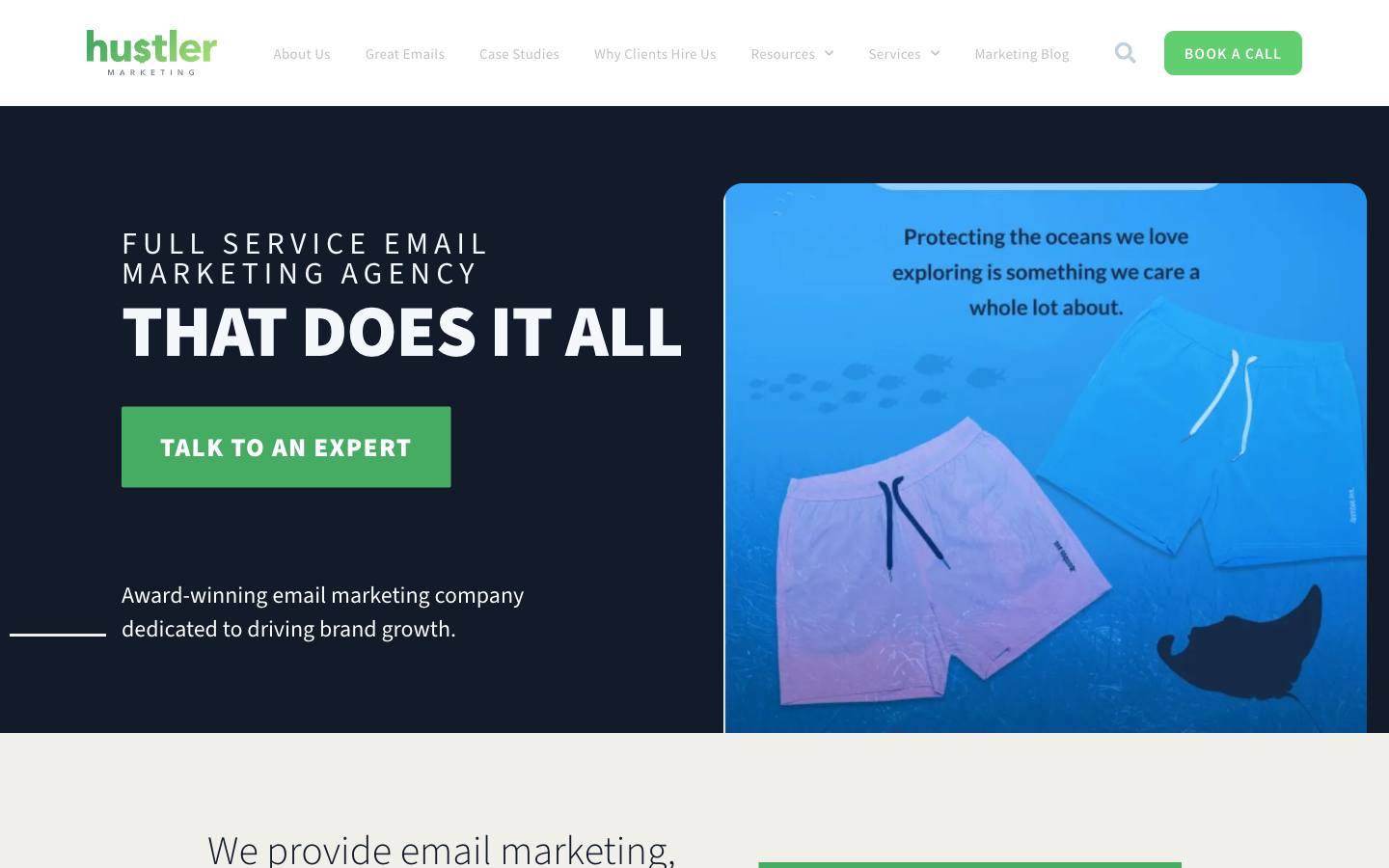
Bottom line: Hustler Marketing is a remote-first, globally distributed email and retention agency founded in November 2017 by Bostjan Belingar, Klaviyo Elite Master, claiming 400+ brands served, delivering through dedicated four-person squads (account manager, copywriter, designer, platform specialist) with account managers capped at three stores each.
The model is the point. A global remote bench keeps prices competitive while the pod cap protects attention, which is a smarter structure than most value-priced shops bother with. Clutch reviewers (17 reviews at 5.0) specifically praise output "comparable to larger agencies at competitive prices."
Pricing: $5,000+ minimum on Clutch, with $10K-49K listed as the most common engagement size.
Honest fit-notes: the team spans 20+ countries with a registered US HQ in Jackson, Wyoming rather than a staffed US office, so brands that want a senior US strategist in their own timezone will feel the difference on Monday morning calls. The agency has also been diversifying into UGC ads, HubSpot consulting, and recruitment services, so ask directly how focused the email practice still is and who is left running it.
8. Homestead Studio: Best for Acquisition and Retention Under One Roof
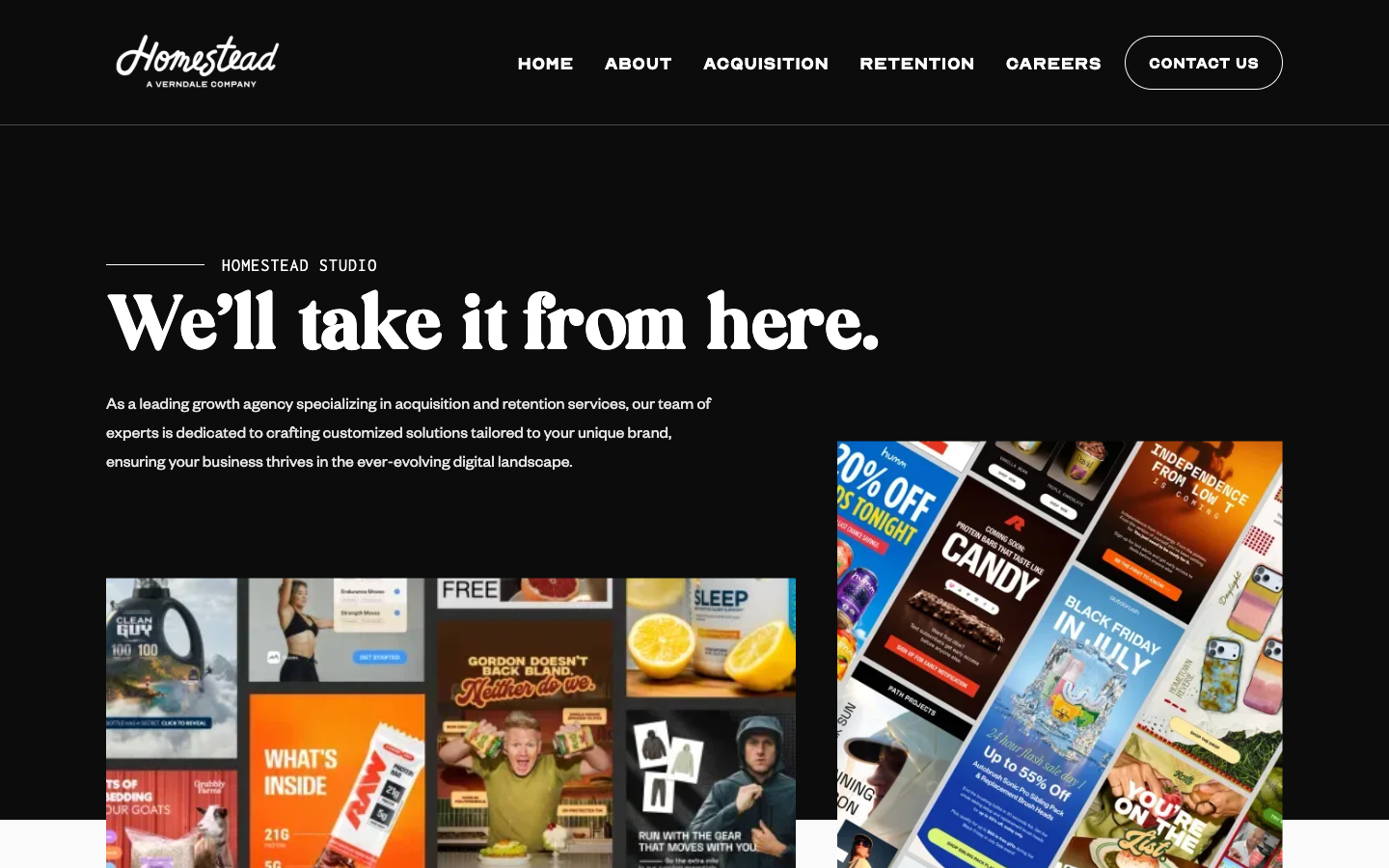
Bottom line: Homestead Studio is an Appleton, Wisconsin full-funnel agency, Klaviyo's 2025 Americas Agency Partner of the Year and an Elite Master partner, splitting its work across email, SMS, paid media, CRO, and web design.
If you want one agency accountable for both sides of your growth economics, acquisition and retention, this is the strongest option here. Clutch lists $5,000 minimums at $200-300/hour, the highest hourly band on this list.
Pricing: $5,000+ minimum projects at $200-300/hour.
Honest fit-notes: email is roughly 20% of what Homestead does, so pure email depth trails the specialists above. Verndale acquired the agency in March 2026, and the homepage now leads with "Homestead Has Joined Verndale," positioning it inside the Verndale family alongside Vaan Group. Acquisitions bring integration churn and repositioning, so ask specifically how the email practice is staffed today and whether the strategist you meet survived the transition. Their Clutch profile currently shows no reviews, so do not treat Clutch as the reference check here. Ask for client references directly.
9. Sticky Digital: Best for Beauty, Wellness, and F&B Boutiques
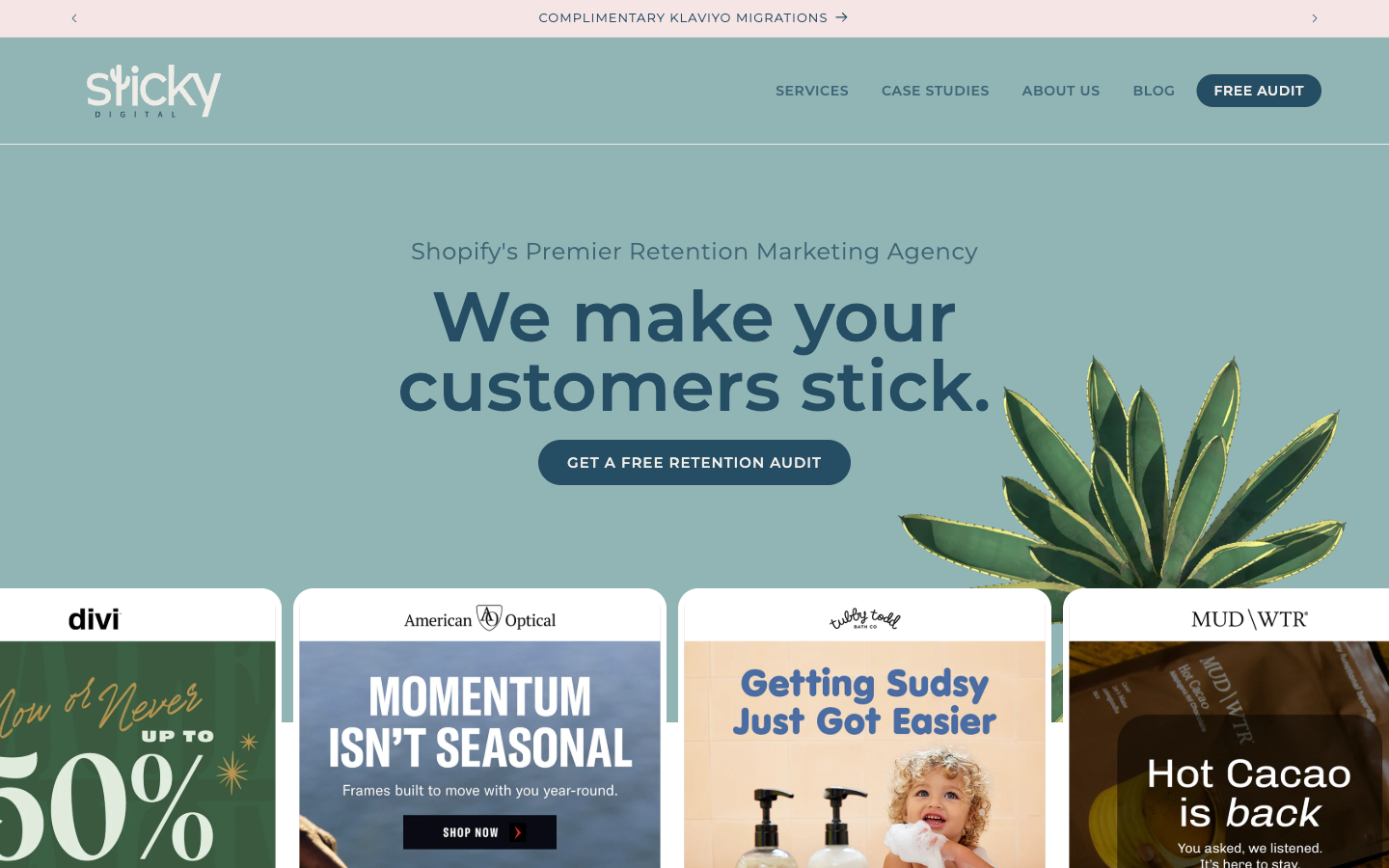
Bottom line: Sticky Digital is a female-founded California retention boutique, co-founded by Nikki Tooman and Mariel Kilroy, doing retention only for DTC brands with predominantly female customer bases. Klaviyo's directory lists it at Platinum Master, in San Diego.
The vertical focus is the entire point: beauty, wellness, food and beverage, apparel. Pattern-matching inside a narrow vertical genuinely beats generalist range, and for a beauty brand that has been through three generalist agencies, that difference shows up in the first campaign calendar. A $1,000 Clutch minimum at $100-149/hour makes it the most accessible specialist entry point here.
Pricing: $1,000+ minimum on Clutch at $100-149/hour.
Honest fit-notes: a few things did not survive our August verification pass, so take them out of your evaluation. Their domain is stickydigital.io, not .com, and half the ranking pages citing them link to the wrong site. Their Clutch profile currently shows no reviews, so there is no third-party review base to check. Clutch lists 10 to 49 employees rather than the "nine-person team" that circulates. And the "35 to 50% of revenue from email and SMS" client claim, which our own previous version repeated, is not on their current site. None of that means the work is bad. It means you should ask for direct references rather than lean on secondhand proof. Brands outside those verticals also lose the pattern-matching advantage that makes Sticky effective in the first place.
10. InboxArmy: Best for Volume Execution and Multi-ESP Teams
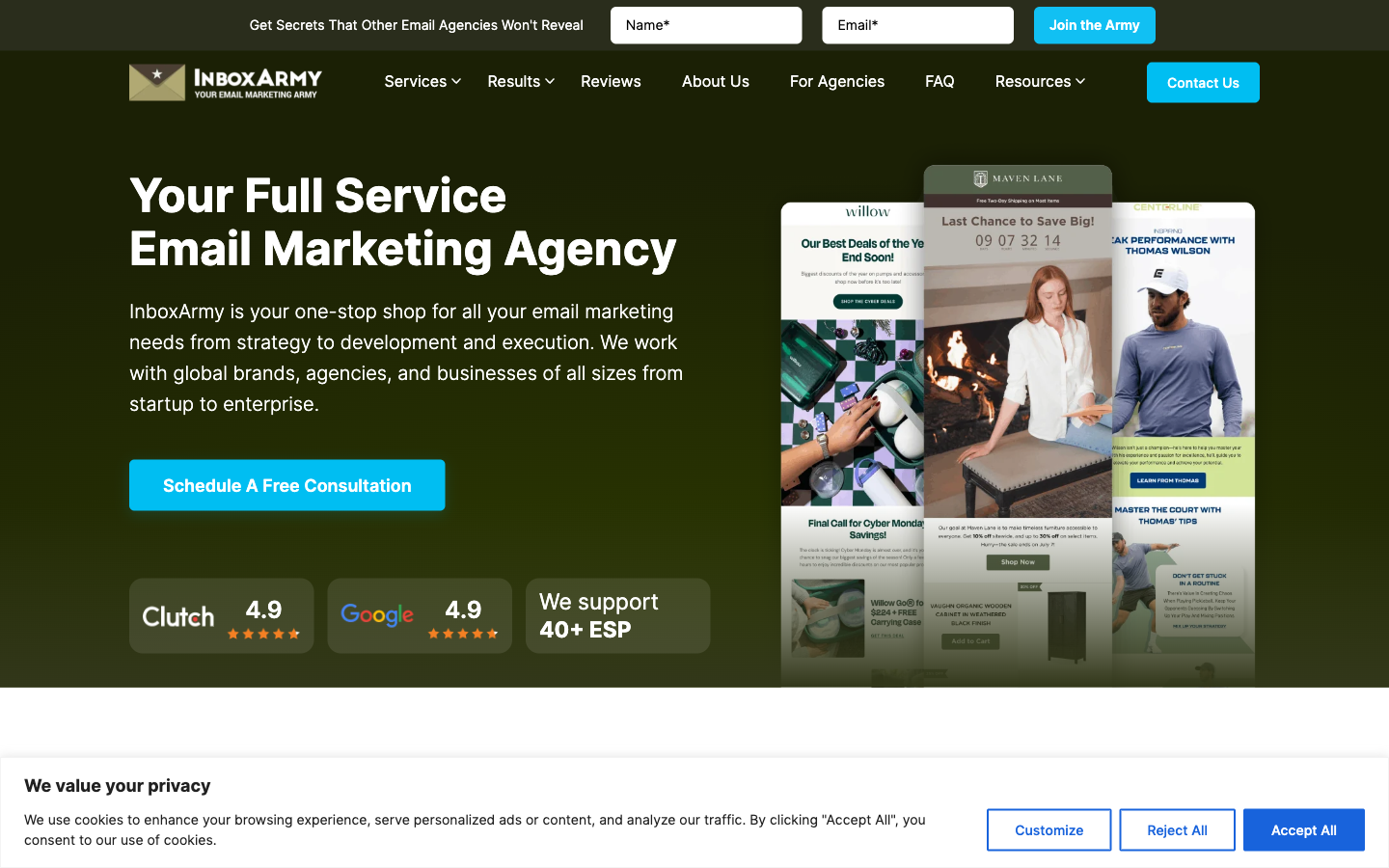
Bottom line: InboxArmy is a Grapevine, Texas production agency of 120+ specialists supporting 40+ email platforms including Klaviyo, with managed services from $1,500/month and a 4.9 rating across 71 Clutch reviews.
For template production, campaign execution at volume, or a brand stuck mid-migration between ESPs, the price-to-output ratio is unmatched on this list, and the multi-platform bench means an ESP switch never strands you. They also do something almost nobody else here does: they put an actual pricing page on their website. That is worth more than it sounds. It is the only entry on this list where the number you read is the number, and it is why they score full marks on pricing transparency despite scoring lowest overall.
Pricing: managed services from $1,500/month, published on their own pricing page. Clutch lists a $1,000 minimum. Their Klaviyo badge reads Master Silver Partner, the lowest tier on this list.
Honest fit-notes: InboxArmy is not a DTC retention specialist. Klaviyo is one of 40+ supported platforms, and you are buying production capacity, not retention strategy. Both are legitimate purchases. Know which one you need before you sign. If your budget is genuinely $1,500 a month, InboxArmy beats us for you, and I would rather tell you that than sell you a retainer you cannot sustain.
Best Shopify Email Marketing Agencies: Does Your Platform Change the Answer?
Mostly no, in exactly two places yes. Every agency on this list works with Shopify brands daily, and Klaviyo, the dominant ESP for Shopify stores, is the shared toolset. Here is what actually changes:
- If your email problems are tangled with site problems, Fuel Made is the only agency here running Shopify Plus development, CRO, and Elite Master email under one senior roof. That combination is rare for a reason, and it matters more than most brands realize. Half the "email is underperforming" audits I run turn out to be capture problems: a popup converting at 1%, a checkout leaking, a product page that never earns the click the email paid for.
- If you are on Shopify Plus at enterprise scale, weigh Underground Ecom and us. Both run programs for 8 and 9-figure Shopify brands. Our own case studies, The Freeze Pipe, Gimme Seaweed, and V-Flat World, are all Shopify stores.
- If you are migrating ESPs on Shopify (Mailchimp to Klaviyo is still the most common), InboxArmy's multi-platform production bench makes migrations cheap and fast. Whether to migrate at all is covered in our Klaviyo vs. Mailchimp comparison.
Everything else in this guide applies to Shopify brands unchanged: the pricing bands, the benchmarks above, the vetting questions below. If you sell software rather than physical products, the answer does change materially, and our SaaS email agency guide covers that instead.
Which Agency Fits Your Revenue Stage?
The honest segmentation nobody publishes, because it turns buyers away:
- Under $1M: skip agencies. A skilled freelancer, your ESP's onboarding, or a done-with-you program (our Retention Lab, or a small scoped engagement with MH Digital) beats a retainer eating your margin. At this stage a $4,400 monthly fee is not an investment, it is a tax.
- $1M to $10M: boutique senior attention wins. MH Digital, Sticky Digital if you are in their verticals, or Flowium's lower tiers. All three list $1,000 project minimums, so this is where scoped pilots make sense before anyone signs a twelve-month retainer.
- $10M to $50M: the full-service sweet spot. The Email Marketers, Flowium, Chronos, Hustler, Fuel Made if you are on Shopify Plus. Expect $4,000 to $10,000 a month, and hold the agency to the trajectory in the benchmark section: past 25% of revenue from email and SMS by month 6.
- $50M+: senior-only premium teams and enterprise shops. The Email Marketers at full scope, Underground Ecom, or in-housing the function with agency support layered on top.
How Much Do Ecommerce Email Marketing Agencies Cost?
Between $1,500 and $18,000+ per month in 2026, and the number tracks the delivery model more than it tracks the results:
- Production shops (InboxArmy): managed services from $1,500/month, published on their site.
- Boutique consultancies (MH Digital, Sticky Digital): $1,000 project minimums, $50-149/hour, usually starting as a scoped pilot.
- Full-service retention agencies (Flowium, Hustler): $1,000 to $5,000 minimums, with Hustler's most common engagements at $10K-49K.
- Premium senior-team programs (The Email Marketers, Fuel Made, Chronos, Homestead): we start at $4,400/month, average $6,500, and run to $18,000 at full scope. Fuel Made and Chronos both carry $10,000+ project minimums; Homestead carries $5,000+ at $200-300/hour, the highest hourly band here.
- Enterprise (Underground Ecom): unpublished, effectively five figures monthly.
Here is the honest thing about every one of those numbers except ours and InboxArmy's: they are Clutch minimums, not rate cards. Two of the ten agencies on this list publish what they charge. The rest publish a button. When you see a specific monthly retainer quoted for an agency on a comparison page, including on the previous version of this one, check whether the agency ever said it. Three of the figures we had been repeating turned out to trace back to nothing but other people repeating them.
The trade-off, honestly stated: with a cheaper agency you are usually paying for a process, and with a premium agency you are paying for the people running it. Lower-priced models hold their economics through templated deliverables, junior or offshore execution, and more clients per strategist. That can be exactly right if your program just needs consistent, competent execution. A premium agency puts senior operators on your account, carries fewer clients each, and does the compounding work: forecasting, roadmapping, structured testing. The failure mode to avoid is the worst of both, a wrong-fit agency charging premium prices for a junior team with weak processes and an overloaded roster. That combination is miserable at any price.
One structural note that buyers underweight: even a premium retainer costs less than the equivalent team in-house. A $6,500 monthly engagement is a fraction of what a senior strategist, copywriter, designer, and implementation specialist cost as four salaries. The full breakdown, including our rate card and the pricing red flags that cost brands money, is in our pricing guide.
How Do You Choose? Six Questions That Reveal Any Agency
- "How are your claimed results measured?" The trick to catch is attribution windows. Klaviyo can be configured to credit email for any purchase within 14 days of an open, and given that Apple auto-opens a huge share of email now, open-based attribution in 2026 is not generous, it is fiction. Ask for the window and whether it counts opens or only clicks. I have audited accounts where that single setting inflated reported email revenue enormously.
- "Who exactly works on my account weekly, and what is their tenure?" Bait-and-switch between the sales team and the delivery team is the most common agency failure there is.
- "Which clients usually do NOT succeed with you?" Honest shops answer instantly. An agency that cannot name a bad-fit client has either never had one or is not telling you the truth, and only one of those is possible.
- "What should email and SMS revenue look like by day 90?" Use the benchmarks above. An agency unwilling to commit to a trajectory has not done this often enough to know their own numbers.
- "Can I meet the actual team?" Skill matters and so does chemistry. You will be on a call with these people every week, and "extremely knowledgeable but you dread the meetings" is a bad trade.
- "What happens in the first 14 days?" A specific answer (audit, deliverability check, attribution reset, quick-win campaigns live by week two) signals a real process. A vague one signals improvisation you are paying for.
More detail on all of this in 7 things you should ask before hiring an email marketing agency.
How Agency Relationships Actually End
Nobody puts this in a ranking, so here it is.
The riskiest moment in any agency relationship is when new stakeholders arrive on the client side. A new marketing lead, a new brand director, a new CMO. Sometimes they bring agencies they already trust. Sometimes they simply do not like the creative direction they inherited. We lost a client exactly that way: the new team wanted a different style, and we were too slow to adapt to it. That one was our mistake, not theirs, and I still think about it. The lesson we took was to treat every new stakeholder as a re-onboarding, not a handover, and to get in front of taste changes before they become a verdict.
It runs the other direction too. We have ended engagements ourselves, and the pattern is consistent. Clients who are rude to our team, and clients who repeatedly break the process: no answers to messages, approvals that arrive after the send date, objectives that change every month, no single point of contact. An agency engagement is a two-sided machine and it does not run on one side alone.
So when you vet an agency, know that a good one is vetting you back. Be a little suspicious of any agency desperate enough not to.
Red flags to watch inside your own account after you hire someone: attribution settings quietly widened to inflate reported revenue. Campaigns blasted to the full list with no segmentation. Flows unchanged 90 days in. Open-rate "wins" that are really Apple inflation rather than clicks or revenue. No monthly reporting. And no clear 90-day roadmap: if you do not know what your agency is doing next month, neither do they.
What Should You Do Next?
If you run a 7 to 9-figure ecommerce brand and email and SMS drive less than 25% of your revenue, the fastest next step is a teardown of your current account. Book a 30-minute audit with me. You get a personalized retention roadmap whether or not we ever work together.
If you are earlier-stage or want to keep it in-house, start here:
- The 12 Best Email Marketing Agencies in 2026, the broader list including B2B and full-service generalists
- How to Choose the Best Klaviyo Email Marketing Agency, if you have already committed to Klaviyo
- Email Marketing Agency Pricing: What It Actually Costs
- The Best SaaS Email Marketing Agencies, if you sell software rather than physical products
- 7 Things You Should Ask Before Hiring an Email Marketing Agency
- Klaviyo vs. Mailchimp
Email is one channel inside a retention program. For agencies scored on the full mandate, including subscriptions, loyalty and direct mail, see the best retention marketing agencies. For the text-message half of the program, see the best SMS marketing agencies.
Running on Shopify specifically? The best email marketing agencies for Shopify stores are scored on a different rubric, weighted toward Shopify depth, and that guide includes the five things that quietly break between Shopify and Klaviyo.
We published the underlying data behind these benchmarks. The State of Ecommerce Retention 2026 covers 109 recorded audits, the full 2% to 49% range of email revenue share, and why the reported figure is usually too high.
Frequently Asked Questions
What is the best ecommerce email marketing agency?
For most 8-figure DTC brands, The Email Marketers, with the disclosure that we wrote this guide and our scoring rubric is published above so you can check the ranking. For growth-stage brands wanting a systematized default, Flowium. For sub-$10M brands, MH Digital or Sticky Digital. For enterprise UK and EU brands, Underground Ecom. For volume production on a budget, InboxArmy. The honest answer depends on your stage, which is why this guide segments by revenue tier.
How much does an ecommerce email marketing agency cost?
Between $1,500 and $18,000+ per month in 2026. InboxArmy publishes managed services from $1,500/month. Boutique consultancies (MH Digital, Sticky Digital) list $1,000 project minimums. Fuel Made and Chronos list $10,000+ project minimums on Clutch. Premium senior-team programs run $4,400-18,000/month. Worth knowing: only two agencies on this list, The Email Marketers and InboxArmy, publish actual rates. Everything else is a Clutch minimum or a sales call.
What percentage of ecommerce revenue should email drive?
Brands typically arrive at about 15% of store revenue from email and SMS, and should be above 25% by month 6 of a competent engagement. For subscription or high-repeat products, 30 to 40% is realistic. Those figures come from The Email Marketers' own client accounts and are measured on click-based attribution. Verify the attribution window before trusting anyone's reported percentage, because wide windows that count email opens inflate the number dramatically.
What percentage of email revenue should come from flows versus campaigns?
Common advice says 50/50. In the most optimized accounts The Email Marketers runs, roughly 70% of email revenue comes from campaigns and 30% from flows. Early in an engagement flows dominate, because fixing broken automations is the fastest available win. As the program matures, campaign volume and quality become the growth engine and the ratio flips. If flows still carry an account that has been managed for a year, the agency stopped sending.
What is a good email open rate for an ecommerce brand in 2026?
60 to 65% on well-segmented campaigns, based on the accounts The Email Marketers runs. That number is inflated by Apple Mail Privacy Protection auto-opens, which is why opens belong in the deliverability column rather than the success column. Judge programs on click rate, where 0.7 to 1.3% is strong in 2026 now that bot clicks are filtered out, and on revenue measured by clicks.
How many campaigns should an ecommerce brand send per month?
12 to 30 per month for 7 and 8-figure brands, and more for 9-figure brands. Since campaigns produce roughly 70% of email revenue in a mature account, low send volume is usually the single largest revenue gap in an underperforming program.
Do I need a Shopify-specific email marketing agency?
Usually not. Klaviyo works identically across Shopify stores and every agency on this list serves Shopify brands daily. The exception is when email problems are tangled with site problems, in which case an agency running both Shopify Plus development and email (Fuel Made) can fix both sides with one team.
Should I hire an agency, a freelancer, or go in-house?
An agency buys you a five-specialist team (strategist, project manager, copywriter, designer, implementation) for roughly the cost of one senior in-house hire at a $70,000-80,000 salary plus overhead. A freelancer is the budget play with capacity risk, since a better client can outbid you for their slots. In-house wins on flexibility and brand intimacy, and it takes real scale to justify. Under $1M, go freelancer or done-with-you. At $5M+, the agency math usually wins.
How long until an ecommerce email agency shows results?
First revenue lift in 2 to 3 weeks, driven by quick-win campaigns, deliverability repairs, and reactivating dormant segments. Sustained compounding improvement takes 60 to 90 days as rebuilt flows and segmentation mature. An agency that cannot describe its first 60 days in specifics does not have a process.
What is a good popup signup rate for an ecommerce store?
6% or higher on a modern popup platform. The old best practice was 3%, which is still roughly what a standard Klaviyo popup converts at. The Email Marketers holds accounts on Alia to a 6% minimum. Doubling capture rate compounds, because it accelerates list growth, flow revenue, and campaign reach at the same time.
Are "best agency" lists trustworthy?
Be skeptical of all of them, including this one. Most ranking pages for this search are written by agencies ranking themselves first with no methodology, or by content sites with no email marketing experience. Look for a published rubric, verifiable client results, real pricing, and honest fit-notes on every entry, then re-score against your own priorities and see whether the order still holds.
About the author

Melanie Balke is the founder and CEO of The Email Marketers, a retention marketing agency for 7 to 9-figure ecommerce brands, and host of the No Mild Takes podcast. She has worked retention from every seat: in-house at an ecommerce brand, as a freelancer, inside another agency, and since 2019 running her own. Her team generated over $100 million in attributed email and SMS revenue for clients in 2025, including Shopify brands The Freeze Pipe, Gimme Seaweed, and V-Flat World. Clients include Grüns, Gimme Seaweed, Elevate Outdoor Collective (the company behind K2 Skis and Völkl), Open Store, and Outer Furniture. She has been featured in Business Insider and Authority Magazine. Book a free 30-minute audit, or connect on LinkedIn and X.
Methodology: agencies are scored on a published 100-point rubric (verifiable results 30, who does the work 25, ecommerce retention depth 20, pricing transparency 15, verified current activity 10) using each agency's own site, Clutch profile, Klaviyo partner directory listing, and published pricing as of August 2026. Every agency was re-verified as currently operating in its claimed form, including a manual visit to each site in August 2026. Agencies appearing on both this list and our Klaviyo agency guide carry identical scores on both pages. The Email Marketers publishes this guide and appears on the list; every entry, including ours, carries honest fit-limitations. Performance benchmarks cited are first-party observations from ecommerce accounts managed by The Email Marketers as of August 2026, measured on click-based attribution.


