.png)


Email Marketing Trends 2025: Complete Guide
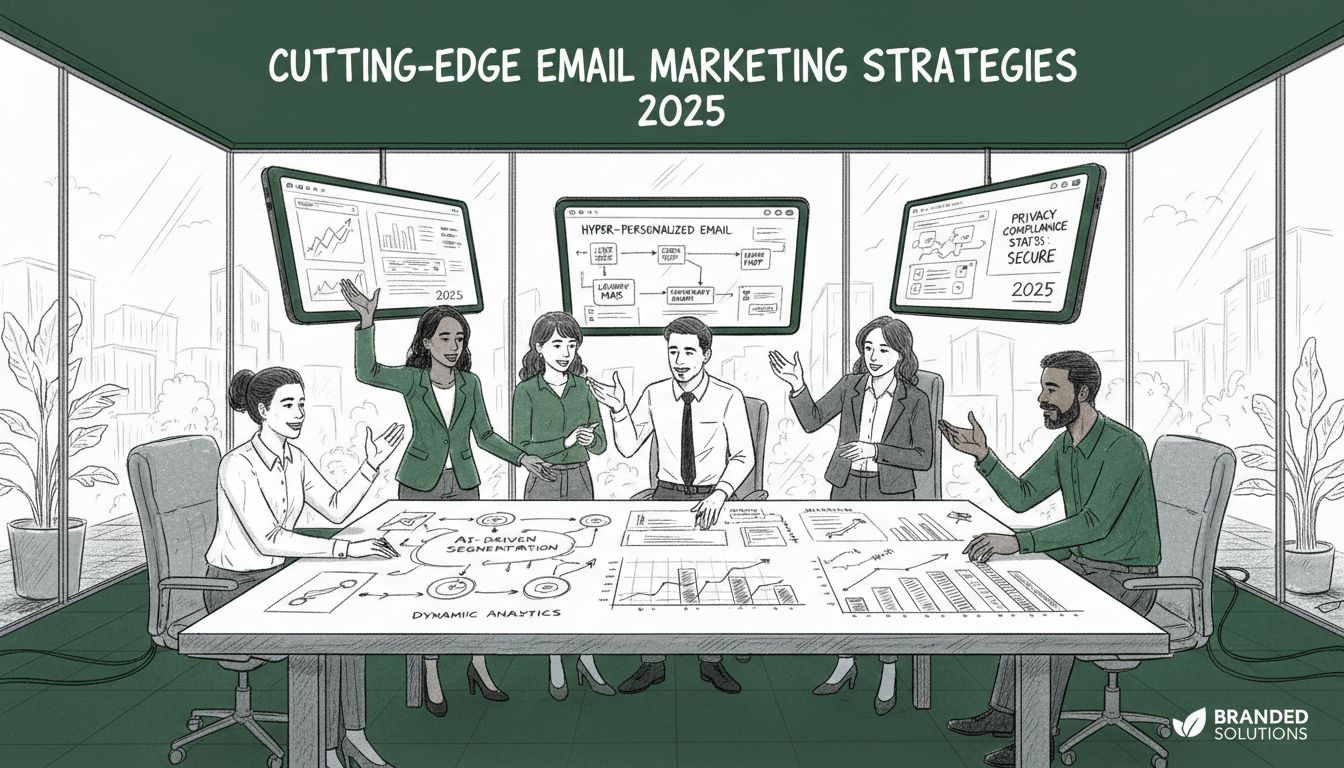
More than 4.6 billion people around the world use email, making it one of the most powerful tools in digital marketing today. As artificial intelligence and privacy laws reshape expectations, brands must rethink the old approaches to stay ahead. This deep dive cuts through the noise to highlight the top email marketing trends in 2025, revealing how innovators are turning generic emails into personalized connections that drive real results.
Table of Contents
Key Takeaways
PointDetailsEmail Marketing EvolutionEmail marketing is shifting towards personalized communications influenced by AI, privacy regulations, and user experience expectations.AI-Driven PersonalizationAI technology enables brands to create hyper-personalized content and optimize segmentation to enhance user engagement.Automation and Omnichannel StrategiesModern email automation focuses on seamless, responsive communication across multiple channels, enriching customer interactions.Privacy and ComplianceAdhering to stringent privacy regulations is crucial for building trust, as consumers expect transparency regarding data usage.
Defining Email Marketing Trends in 2025
Email marketing is undergoing a transformative evolution in 2025, driven by technological advancements and changing consumer expectations. According to aamctraining.edu, over 4.6 billion people globally use email, with projections indicating this number will reach 4.9 billion by 2027. This massive user base underscores email’s enduring relevance in digital communication strategies.
The landscape of email marketing is being reshaped by three critical developments: artificial intelligence integration, enhanced privacy regulations, and increasingly sophisticated user experience expectations. By 2025, brands are moving beyond generic mass communication toward highly personalized, contextually relevant email interactions. Everything-PR highlights that successful email strategies now emphasize user-generated content and social proof to build genuine trust and community engagement.
Key trends defining email marketing in 2025 include:
The future of email marketing is not about sending more emails, but sending smarter, more meaningful communications that resonate with individual consumer preferences and behaviors.
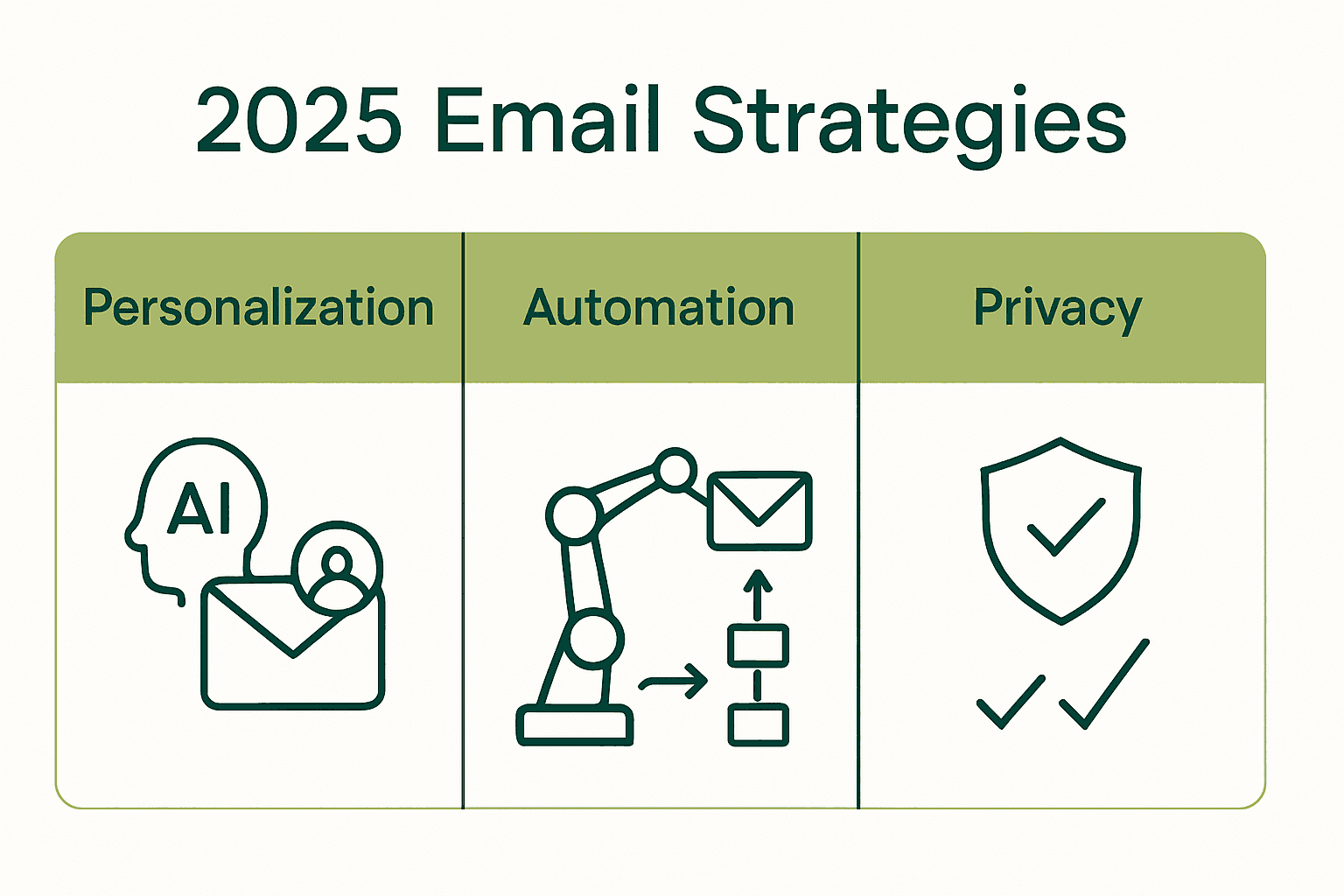
Brands that master this nuanced approach will transform email from a simple communication channel into a powerful relationship-building tool.
AI-Driven Personalization and Segmentation
As email marketing evolves, artificial intelligence has become the cornerstone of creating hyper-personalized customer experiences. According to research from arXiv, personalized AI assistants can significantly enhance marketing campaign quality by leveraging users’ psychometric profiles and understanding individual work styles. This technological breakthrough transforms how brands communicate with their audiences, moving beyond generic messaging to truly individualized interactions.
The power of AI in email segmentation lies in its ability to analyze complex data patterns and predict consumer behavior with unprecedented accuracy. arXiv demonstrates this potential through SLM4Offer, a generative AI model that improved offer acceptance rates by 17% using advanced contrastive learning techniques. These sophisticated algorithms can now:
Advanced segmentation is no longer just about demographics or purchase history. Modern AI-driven strategies dive deep into behavioral nuances, psychographic insights, and real-time interaction data. Brands that successfully implement these intelligent segmentation techniques can create email experiences that feel less like marketing and more like personalized conversation. When done right, AI transforms email from a broadcast medium into a one-to-one communication channel that truly understands and anticipates individual customer needs.
For marketers looking to implement these cutting-edge strategies, email personalization techniques represent the next frontier of customer engagement. By embracing AI-powered segmentation, businesses can craft email experiences that are not just seen, but genuinely appreciated by their audience.
Automation and Omnichannel Integration Evolution
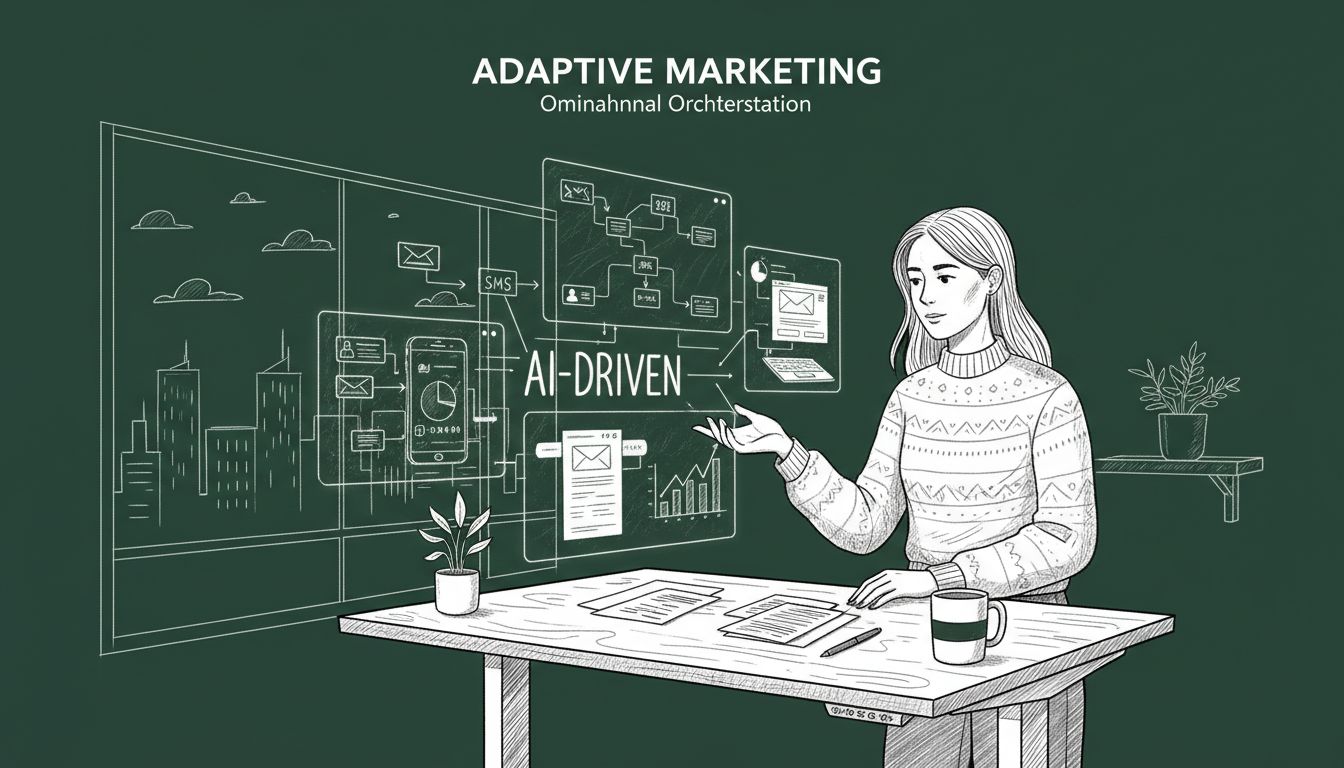
Email marketing automation is rapidly transforming from a simple scheduling tool to a sophisticated, intelligent communication ecosystem. According to Enetos, automation in 2025 will streamline communication by ensuring timely and relevant interactions through dynamically triggered drip campaigns that respond to specific user actions. This evolution means marketers can create more nuanced, responsive communication strategies that feel personalized and immediate.
The integration of advanced computational frameworks is revolutionizing how brands approach multichannel marketing. arXiv highlights the Neural Optimization with Adaptive Heuristics (NOAH) framework, which demonstrates significant improvements in marketing communication across owned and paid channels. Key automation strategies now include:
Omnichannel integration goes beyond simply connecting different communication platforms. It’s about creating a seamless, cohesive customer journey where each interaction builds upon the last, regardless of the touchpoint. Modern automation tools now enable businesses to track and respond to customer interactions across email, social media, websites, and mobile platforms, creating a unified narrative that feels both personalized and intuitive.
For marketers seeking to master these advanced strategies, understanding omnichannel marketing is crucial. The future of email marketing lies not just in sending messages, but in creating intelligent, adaptive communication ecosystems that anticipate and respond to individual customer needs with unprecedented precision.
Regulatory and Privacy Shifts Impacting Email
Email marketing in 2025 is experiencing a profound transformation driven by increasingly stringent privacy regulations. According to AAMC Training, a critical shift is emerging where transparency and consent are no longer optional, but fundamental to successful digital communication. A landmark 2024 Deloitte study revealed that 82% of consumers are more likely to engage with brands that are upfront about data usage, signaling a dramatic change in consumer expectations around data privacy.
The regulatory landscape now demands comprehensive, proactive approaches to data management. Key privacy considerations for email marketers include:
These evolving regulations, including frameworks like GDPR and CCPA, are reshaping email marketing strategies. Brands that prioritize clean email lists obtained through ethical means are seeing tangible benefits, with studies showing 25% higher engagement rates compared to less transparent collection methods. This isn’t just about compliance—it’s about building genuine trust with your audience by demonstrating respect for their personal information.
For marketers navigating these complex privacy landscapes, understanding the nuanced legal requirements is crucial. Email marketing laws have become an essential component of digital marketing strategy, transforming data collection from a transactional process to a relationship-building opportunity. The future of successful email marketing lies in creating transparent, consensual communication ecosystems that prioritize user privacy and data protection.
E-Commerce Retention Strategies for High ROI
In the competitive landscape of digital commerce, retention strategies have become the cornerstone of sustainable growth. According to AAMC Training, email marketing continues to deliver extraordinary value, with Litmus reporting an astonishing $42 return for every $1 spent. This remarkable statistic underscores why smart e-commerce brands are doubling down on sophisticated email retention approaches that go far beyond simple communication.
Advanced e-commerce retention strategies now leverage cutting-edge technologies to create personalized experiences. arXiv highlights the emerging trend of using large language models to generate hyper-targeted email content, including thematic titles that dramatically improve customer engagement. Key strategies for maximizing email marketing ROI include:
The most successful e-commerce brands recognize that retention isn’t about frequency, but relevance. Email remains 40 times more effective at acquiring customers compared to social media platforms, making it a critical channel for building long-term customer relationships. By combining data-driven insights with creative personalization, businesses can transform transactional interactions into meaningful, loyalty-building experiences.
For marketers seeking to elevate their retention game, re-engagement campaign strategies represent the next frontier of customer loyalty. The future of e-commerce email marketing lies in creating intelligent, adaptive communication that feels less like marketing and more like a personalized conversation.
Common Pitfalls and Best Practices for 2025
Email marketing in 2025 demands a sophisticated, nuanced approach that goes far beyond traditional metrics and tactics. According to Enetos, marketers must navigate a complex landscape of potential pitfalls and strategic opportunities. The most critical errors include neglecting personalization, failing to optimize for mobile experiences, and overlooking the power of sophisticated automation workflows.
AAMC Training emphasizes that modern marketers must shift from superficial engagement metrics to meaningful interaction tracking. This means moving beyond simple ‘open rates’ to analyze deeper signals like:
The most successful email marketing strategies in 2025 will prioritize intelligent, adaptive communication. This requires a holistic approach that combines technological sophistication with genuine human understanding. Marketers must leverage AI-powered tools for optimization while maintaining an authentic, personalized touch that resonates with individual audience segments.
For brands looking to elevate their email marketing game, the ultimate email marketing strategy guide provides crucial insights into navigating these complex landscape. The future belongs to those who can transform email from a mere communication channel into a precision instrument of customer engagement and loyalty.
Elevate Your Email Marketing with Strategic AI-Driven Solutions
The challenges highlighted in “Email Marketing Trends 2025: Complete Guide” show how crucial it is to move beyond basic campaigns and master advanced personalization, AI-powered segmentation, and privacy compliance. If you are struggling with transforming generic messages into meaningful customer conversations or seeking to unlock higher engagement and retention through smarter automation, you are not alone. The growing expectations for dynamic, behavior-driven email strategies demand expert execution combined with innovative technology.
At The Email Marketers, we specialize in delivering exactly what modern e-commerce brands need. Our tailored, AI-supported email and SMS marketing solutions focus on retention marketing proven to increase customer lifetime value and maximize ROI. By leveraging data-driven segmentation, automated workflows, and personalized content strategies, we help you avoid common pitfalls while building authentic connections that turn customers into lifelong advocates.
Ready to embrace the future of email marketing and drive measurable growth today Explore how our expert team can optimize your campaigns to exceed the evolving trends by visiting The Email Marketers now. Discover winning strategies for email personalization techniques and master omnichannel marketing to stay ahead in 2025 and beyond.
Frequently Asked Questions
What are the key email marketing trends for 2025?
Key trends in email marketing for 2025 include AI-powered subject line optimization, dynamic content personalization, enhanced data privacy compliance, interactive and multimedia email experiences, and advanced segmentation using predictive analytics.
How is artificial intelligence influencing email marketing?
Artificial intelligence is enhancing email marketing by enabling hyper-personalized customer experiences, precise audience segmentation, and automated content generation tailored to individual consumer preferences and behaviors.
What should marketers consider regarding data privacy in email marketing?
Marketers should prioritize explicit consent mechanisms, transparent data usage policies, easy opt-out processes, comprehensive data protection protocols, and regular consent verification to adhere to evolving privacy regulations.
How can e-commerce brands improve customer retention through email marketing?
E-commerce brands can improve retention by leveraging personalized product recommendations, segmented re-engagement campaigns, predictive purchasing behavior analysis, dynamic content adaptation, and automated post-purchase follow-up sequences.


