.png)


Data-Driven Marketing Strategies That Maximize ROI

TL;DR:
- Data-driven marketing transforms customer and campaign data into measurable actions, increasing profitability. Building a unified customer view requires resolving data fragmentation through identity resolution and a Customer Data Platform. Regular reviews and testing ensure campaigns stay aligned with goals and adapt to changing customer behaviors.
Data-driven marketing strategies are systematic approaches that turn customer and campaign data into measurable actions, producing higher profitability and better acquisition outcomes. Organizations that analyze customer data achieve 23 times higher customer acquisition rates and 19 times higher profitability than those that do not. That gap is not a rounding error. It reflects the compounding advantage of making decisions from evidence rather than instinct. This guide covers the core analytic techniques, the fragmentation problem that derails most teams, and the review cadences that keep campaigns performing over time.
What are the best data-driven marketing strategies for ROI?
Analytics-based marketing techniques fall into four categories, each with different data requirements and timelines. Knowing which to apply first prevents wasted budget and months of delay.

Customer Lifetime Value (CLV) analysis measures the total revenue a customer generates over their relationship with your brand. It requires 12+ months of transaction history and cohort sizes of at least 100 customers, delivering usable insights within 2–4 weeks. CLV is the right starting point for most e-commerce teams because it immediately connects marketing spend to long-term profitability.
Marketing Mix Modeling (MMM) quantifies the revenue contribution of each channel across your entire media mix. It demands 18–24 months of multi-channel daily data across five or more channels and takes 3–6 months to produce initial results. MMM is a mature-team tool. Attempting it without sufficient data history produces misleading outputs that misallocate budget.
Multi-Touch Attribution (MTA) assigns credit to individual touchpoints along the path to purchase. It works well for lower-funnel, direct-response campaigns but breaks down for brand awareness efforts where the causal chain is long and indirect. Treat MTA as a tactical signal, not a strategic budget guide.
Predictive analytics and cohort analysis sit between CLV and MMM in complexity. Cohort analysis groups customers by acquisition date or behavior and tracks how each group performs over time. Predictive models extend that logic forward, estimating which customers are likely to churn or convert next.
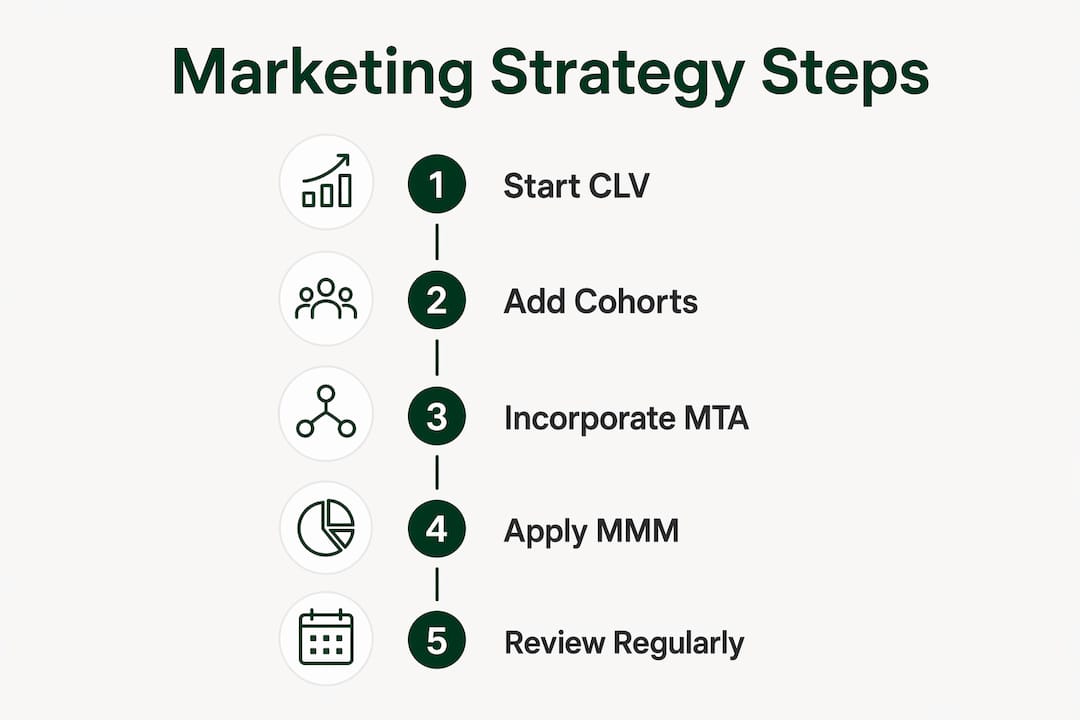
Pro Tip: Sequence these methods by maturity. Start with CLV and cohort analysis in year one, add MTA for direct-response channels in year two, and build toward MMM only after you have 18 months of clean, unified data.
| Technique | Data needed | Time to insight |
|---|---|---|
| CLV analysis | 12+ months, 100+ cohort | 2–4 weeks |
| Marketing Mix Modeling | 18–24 months, 5+ channels | 3–6 months |
| Multi-Touch Attribution | 6+ months, digital channels | 1–2 weeks |
| Cohort analysis | 6+ months of orders | 1–2 weeks |
How does data fragmentation block a unified customer view?
Data fragmentation across 10–20 tools is the primary barrier marketing leaders cite when explaining why their analytics programs fail. The problem is not a lack of data. Most brands have too much of it, scattered across ad platforms, CRMs, email tools, and point-of-sale systems that never talk to each other.
The consequence is a fractured picture of the customer. A purchase recorded in one system does not connect to the email open in another or the paid ad click in a third. Attribution breaks. Budget decisions rest on incomplete signals. Retention programs target the wrong people at the wrong time.
Building a unified customer view requires identity resolution: the process of linking records from different systems to a single customer profile. This is what a Customer Data Platform (CDP) does at scale. Without it, your analytics-based marketing rests on guesswork dressed up as data.
Here is a practical sequence for unifying your data:
- Audit your current stack. List every tool that collects customer data and identify what identifiers each uses (email address, phone number, device ID, cookie).
- Establish a primary key. Choose one identifier, typically email address, as the master link across all systems.
- Map data flows. Document how data moves between tools and where gaps or duplications occur.
- Implement a CDP or data warehouse. Route all customer data through a single repository where records can be matched and merged.
- Validate before acting. Run a sample audit comparing unified profiles against raw source records to catch merge errors before they corrupt campaign targeting.
Pro Tip: You do not need a perfect data stack to start. A unified spreadsheet pulling weekly exports from your top three tools beats waiting six months for a CDP implementation. Act on good enough data now and refine the infrastructure in parallel.
How do you use data to build personalized marketing campaigns?
Personalized marketing strategies built on behavioral data consistently outperform generic broadcast campaigns. The mechanism is simple: messages that reflect what a customer has actually done convert at higher rates than messages built on demographic assumptions alone.
Dynamic RFM modeling (Recency, Frequency, Monetary value) generates meaningful retention segments from as little as six months of order data. RFM is not a one-time exercise. Customer behavior shifts, and static segments go stale within weeks. Automated RFM updates ensure your win-back campaigns reach customers who have actually lapsed, not those who bought yesterday.
Effective personalization combines three data layers:
- Behavioral data: purchase history, browse behavior, email engagement, and on-site search queries
- Demographic data: location, device type, and acquisition source
- Predictive signals: churn probability scores, next-purchase likelihood, and product affinity models
Automation closes the gap between insight and action. Identifying a high-churn-risk segment is worthless if your team manually exports a list and uploads it to a campaign tool once a month. Connecting your analytics layer directly to your email and SMS platform means the right message fires within hours of the triggering behavior. Theemailmarketers builds these automated flows for e-commerce brands, linking segmentation logic directly to campaign execution so no high-value customer falls through the cracks.
Test-and-learn is the operating model that makes personalization compound over time. Run frequent experiments on subject lines, send times, offer structures, and segment definitions. Small, fast tests generate more usable signal than large, slow ones.
“Testing velocity, or how many experiments a marketing team runs monthly, is a stronger predictor of success than the sophistication of the tools they use. Brands running hundreds of concurrent experiments consistently outperform those debating creative direction in committee.”
For e-commerce brands combining paid and owned channels, integrating paid ads with email creates a feedback loop where ad audience data sharpens email segmentation and vice versa.
What review cadences keep data-driven campaigns effective?
Structured review schedules are what separate teams that improve from teams that plateau. Without a fixed cadence, data sits in dashboards nobody reads and campaigns run on last quarter’s assumptions.
Weekly reviews cover traffic volume, email open and click rates, SMS engagement, and ad spend pacing. These are leading indicators. They tell you whether something is breaking before it shows up in revenue numbers.
Monthly reviews cover conversion rates, channel-level performance, customer acquisition cost (CAC), and contribution margin per customer. Contribution margin per customer is the metric most teams skip. It connects marketing directly to profitability rather than stopping at revenue, which can mask unprofitable growth.
The LTV:CAC ratio belongs in every monthly review. A ratio below 3:1 signals that acquisition costs are eroding the value of the customers you are buying. A ratio above 5:1 often signals underinvestment in growth.
For budget decisions, randomized incrementality testing is the most defensible method. Holdout tests and geo-lift experiments measure the actual causal impact of a channel, rather than the correlational credit that attribution models assign. Before reallocating significant budget between channels, run a controlled experiment. Attribution models will tell you a story. Incrementality tests will tell you the truth.
Key metrics to track at each cadence:
- Weekly: sessions, email open rate, SMS click rate, ad impressions, and spend pacing
- Monthly: conversion rate by channel, CAC, LTV:CAC ratio, contribution margin, and churn rate
- Quarterly: CLV by cohort, MMM output review, and segment performance against retention targets
Integrate these reviews into a standing calendar event with a fixed owner and a shared dashboard. Reviews that depend on someone remembering to run them do not happen consistently.
Key Takeaways
Data-driven marketing succeeds when analytic techniques match your data maturity, customer profiles are unified across tools, and review cadences are fixed and owned.
| Point | Details |
|---|---|
| Start with CLV analysis | Use 12+ months of transaction data to connect marketing spend directly to long-term profitability. |
| Unify data before scaling | Resolve identity across tools using a primary key like email address before building complex attribution models. |
| Use dynamic RFM segmentation | Six months of order data is enough to generate automated retention segments that update in real time. |
| Run incrementality tests for budget calls | Holdout and geo-lift tests reveal true causal impact; attribution models alone mislead large budget decisions. |
| Fix your review cadence | Weekly engagement reviews and monthly profitability reviews catch problems before they compound. |
Why most data-driven programs stall before they deliver
I have worked with enough marketing teams to recognize the pattern immediately. The program starts with ambition: a new analytics platform, a data audit, a roadmap with six workstreams. Six months later, nothing has shipped. The team is still debating data quality.
The uncomfortable truth is that waiting for perfect data is a form of avoidance. Good enough data acted on quickly produces more growth than perfect data acted on slowly. I have seen brands with messy, incomplete customer records run 20 experiments a month and outperform competitors with pristine CDPs who run two.
The other mistake I see constantly is leading with complex models. Teams build sophisticated multi-touch attribution systems before they have a clear answer to the simplest question: which customers are worth keeping? Start with CLV. Understand who your best customers are and what they have in common. Every other analytic technique builds on that foundation.
The brands that win are not the ones with the most data. They are the ones with a culture of fast, cheap experimentation and the discipline to review results on a fixed schedule. Build that culture first. The tooling will follow.
— Melanie
How Theemailmarketers turns data into retention results
Theemailmarketers works with 8-figure DTC brands and growth-focused e-commerce retailers to translate customer data into campaigns that drive repeat purchases and increase lifetime value. The team builds automated segmentation flows using dynamic RFM logic, connects behavioral data to email and SMS triggers, and runs structured test-and-learn programs that compound over time. If your current campaigns rely on static lists and gut-feel send schedules, the retention results from brands that have made the shift tell a clear story. For teams ready to build a full retention system, the Retention Lab offers a structured program designed around your specific data and customer base. Book a free analysis to see where your biggest opportunities are.
FAQ
What are data-driven marketing strategies?
Data-driven marketing strategies are systematic approaches that use customer and campaign data to guide decisions on targeting, messaging, and budget allocation. The goal is to replace assumptions with evidence, producing higher acquisition rates and profitability.
How much data do I need to start?
Six months of order data is enough to build RFM segments and run cohort analysis. CLV analysis requires 12+ months of transaction history with cohort sizes of at least 100 customers.
What is the biggest barrier to data-driven marketing?
Data fragmentation across 10–20 disconnected tools is the primary barrier most marketing leaders identify. It prevents building unified customer profiles and corrupts attribution and budget decisions.
How do I measure whether my marketing is actually working?
Use randomized incrementality testing, such as holdout or geo-lift experiments, for major budget decisions. Track contribution margin per customer and LTV:CAC ratios monthly rather than relying solely on attribution model outputs.
How often should I review marketing performance data?
Review traffic and engagement metrics weekly and conversion rates, CAC, and contribution margin monthly. Fix these reviews to a standing calendar event with a named owner to make them consistent.


